16 When Jacob woke from his sleep he said, ‘Truly the Lord is in this place, and I did not know it.’ 17He was awestruck and said, ‘How awesome is this place! This is none other than the House of God; it is the gateway to heaven.’ 18Early in the morning, when Jacob awoke, he took the stone on which his head had rested, and set it up as a sacred pillar, pouring oil over it.
Genesis 28: 16 – 18 – The Revised English Bible
1I will lift up mine eyes unto the hills, from whence cometh my help. 2My help cometh from the Lord, which made heaven and earth.
Psalm 121: 1-2 – The King James Bible
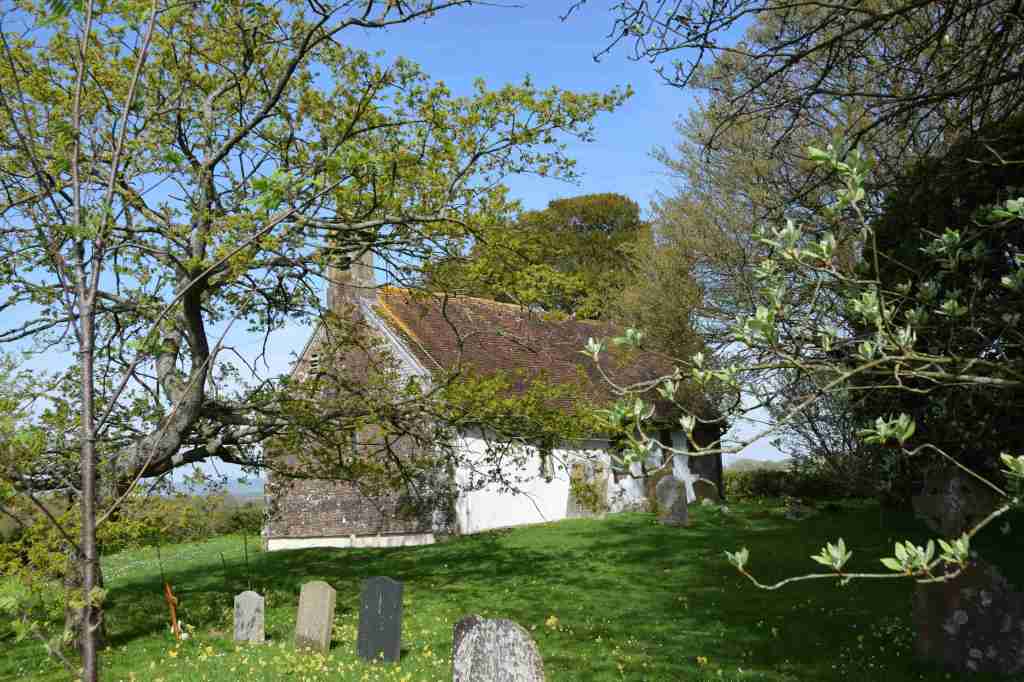
Most of those reading this blog know of my interest in church buildings. I enjoy the soaring, Cathedral-like spaces, some of which are magnificent tributes to Mankind’s ingenuity and creativity, and the best can take your breath away.
But, for me, the most moving visits that I’ve ever made to church buildings have been to the humble places; to the buildings that look and feel as though they’ve grown up out of the ground, rather than been planted on it. These buildings speak of God; they are in the words of Jacob in Genesis: ‘the gateway to heaven.’
One such is St Andrew’s, Didling in West Sussex. For those of you unable to make a pilgrimage there in person, I’m going to try the impossible; to explain what it’s like and to try to give you a sense of the spirituality of this most special of places. St Andrew’s would never feature in a collection of the ‘best’ church architecture. This place is less, and yet so much more.
If you’re able to visit Didling church, do try to leave your car in the village and walk up to the church. Not only will this give you time to transition from the modern world you’re leaving, to the ancient one you’re headed for, but you’ll be following the farm track that’s been trodden for centuries by those who’ve counted Didling as the place where they’ve offered up their thanks, their praise and their supplication to a benevolent Father.
As you walk slowly up the dusty track, you’ll be walking towards the steepness of the Sussex Downs. There’s nothing ahead of you, other than fields and the South Downs. This chalk grassland is too steep to have been commandeered for housing. In fact, it’s also too steep for arable farming. This is sheep country, and has been for centuries, which is why St Andrew’s is known as ‘The Shepherd’s Church.’
The short walk allows us to ponder why the shepherds were the first to announce the arrival of the Christ-child. They were, perhaps, specially chosen by God, because in first century Palestine, they were the ‘lowest of the low’ in the social hierarchy. Christ didn’t come for the rich and powerful, but, in his words in St Luke’s gospel: ‘He has sent me to announce good news to the poor’.
When, after a few minutes, you reach the church, take a breath, stop and listen. If you’re lucky, you’ll hear the bleating of many lambs, grazing in the fields around the church. They too are part of the congregation of St Andrew’s. Their bleating for their mothers echoes our own prayer bleating, to our Father in heaven. The sound talks of a combination of God, nature and mankind, in exactly the way that Our Father always intended. Contemplate this, as you look around and take in the view; this reveals nature and mankind, in perfect harmony. It’s as far as it could be from the Green activists’ view of mankind as a foul polluter of the earth; an evil to be wiped out. We’re all of us loved, and so are the lambs. It’s not difficult to accept this as a fact, as you stand there.
Inside the gate, look at the massive Yew tree. I like to think that these sites long pre-date Christianity, and I think there’s some evidence that Yew trees were sacred to the Druids. The current one might not have stretched back that far (although it’s not impossible; the Woodland Trust thinks they can live up to 3,000 years and the Druids were still around in these islands 1,800 years ago). Not only is the yew at Didling enormous, but it also carries the scars of a near disaster in 1945. Workmen who were sent to trim a branch that was threatening the church, started to fell the tree. The axe marks can still be seen at the base, but it lives to fight another day.
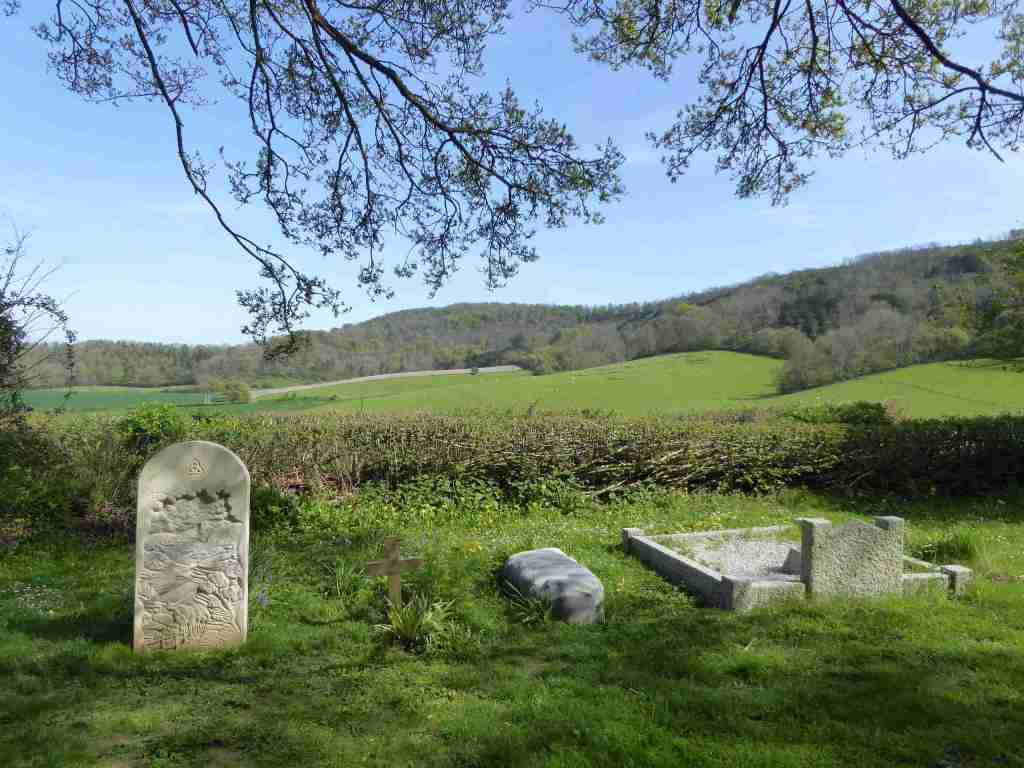
In the churchyard, there’s a gravestone commemorating the Reverend Greville A Grubb, who died in September 2021. As befits such a sacred space, this is one of the most beautiful gravestones I’ve ever seen, and on the edge of the stone is the quotation from Psalm 121 that I’ve copied above: ‘I will lift up mine eyes unto the hills, from whence cometh my help.’ Lift up your own eyes to the South Downs, as the Reverend Grubb must have done many times and give thanks, not just for Greville Grubb, but for all those who have led worship in this place over the centuries. Did the Druids also lift up their eyes on Midsummer’s morn from this spot? It’s easy to think so.
The exterior of the church architecturally is all ‘Early English’, ie it was all built around 1200 or maybe a bit earlier. The architecture itself is entirely unremarkable; just a simple one cell church which has thankfully been too remote and too poor ever to attract the attention of modernisers or restorers. You may notice that there’s a large repair on the South Eastern wall. Maybe this denoted a collapse at some time in the church’s long history? It would not be remarkable if, at one or more points in its long history, the church had been neglected; we only need to know that it’s now lovingly cared for. At the time of one of my recent visits, the churchyard was full of cowslips, sadly now not as common as they were in my childhood.
Take one more look at the wonderful view, and step into the church.
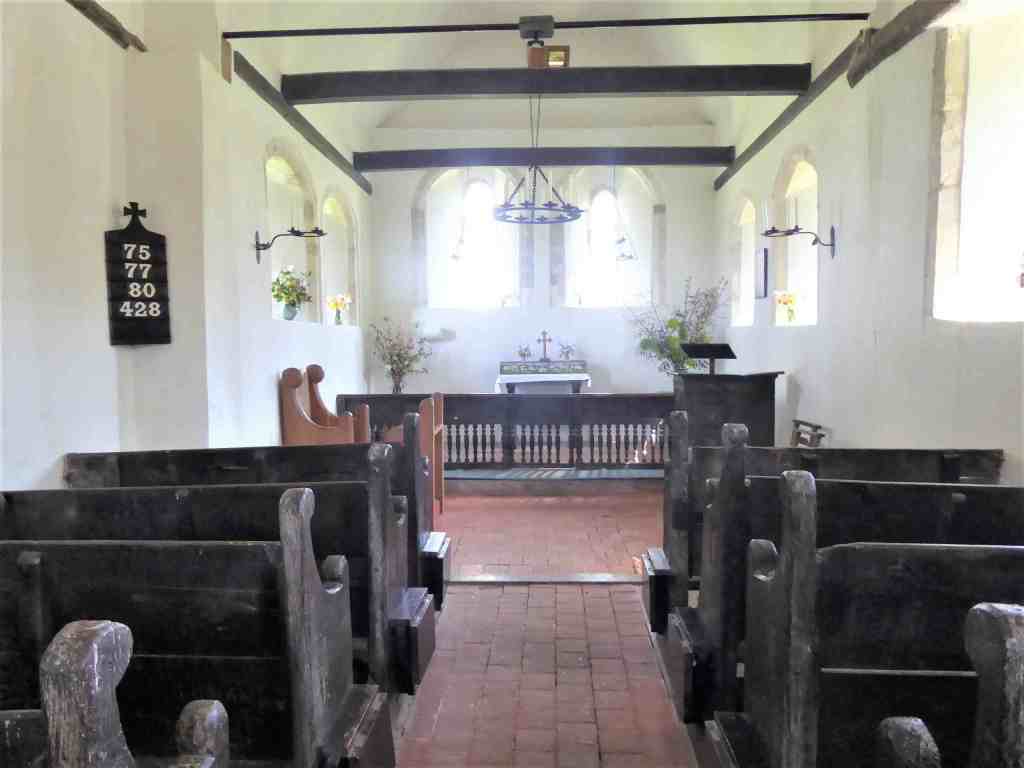
Stand at the back and let its spirituality wash over you; it’s almost tangible. Here is an unpretentious little gem. It’s impossible to imagine Christ preaching and teaching in Westminster Abbey, but you can sense that he would have felt at home here.
The distance from the front to the back of the church is short; in fact, I would say that in addition to its other qualities, St Andrew’s speaks of the equality of all comers. Here, in medieval times, there were no special seats for the local gentry, as you find in many churches. Quite the contrary, here the Squire (if there has ever been such a thing in Didling’s history), would have been close enough to smell his own farmworkers, tenants and neighbours. All the pews are the same and, very unusually, have survived from medieval times – possibly from the early 1400s. The maximum capacity of the church would have been about 30, until more recent times when hinged seats (visible in the picture above), added to the outside of the pews, would have allowed another 12 or so to perch, for important services and funerals. Not only does the age of the blackened pews speak volumes, but these aren’t beautifully crafted pieces of professional joinery. Rather they are rustic, almost as if one of the shepherds had made them as best he could, with the materials lying around and using his limited carpentry skills. The width of the seating area is narrow – all the better to ensure that no-one was accused of dozing off during the vicar’s sermon?
The flowers that adorn the church tell us that the church is still deeply loved by its possibly tiny congregation, as does the beautifully embroidered altar frontal for the tiny altar, depicting – what else? – Sheep and lambs. The first hint we have that there may have been an earlier church on this site (often in Saxon days wooden churches were built on such sites) is the font.
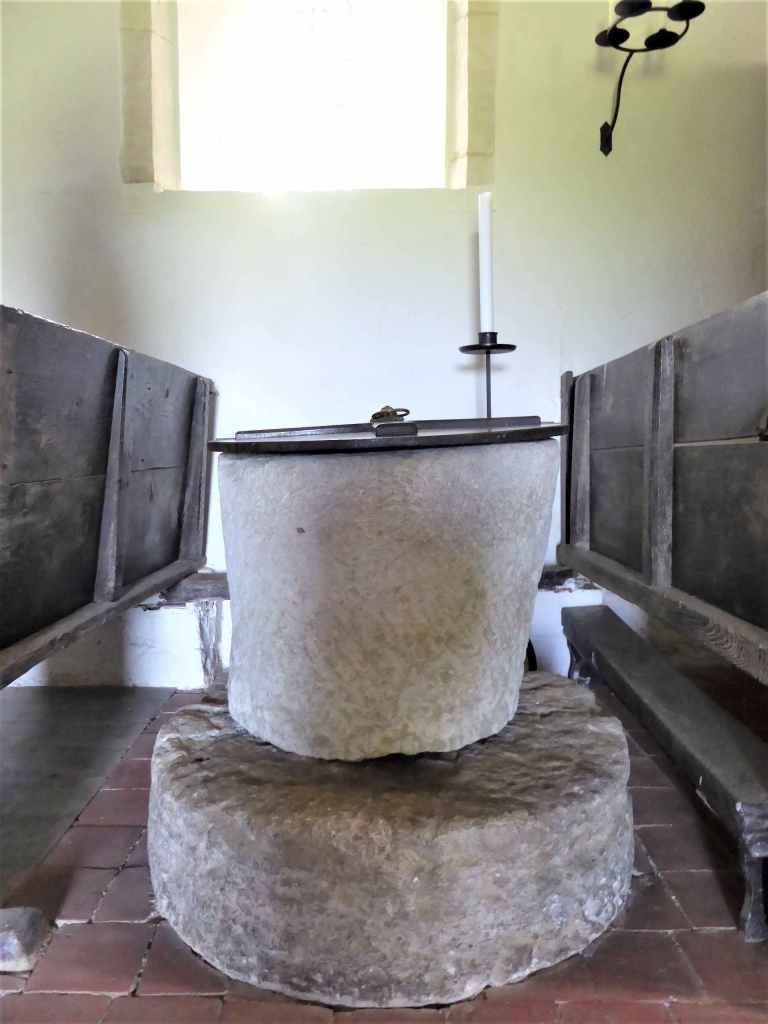
Again this is beautifully rustic. Ponder how old this might be (it is said to be one of the oldest in the country); how many babies would have been baptised in it over the centuries and ponder the passing of the generations. I always find this puts the woes of the current world into perspective; many of the babies baptised here would never have made it to adulthood. This crudely hewn piece of local stone is again likely ‘home-made’ and stands at a jaunty angle, with simple wooden lid. It is a thing of beauty that competes with the grandest of East Anglian ‘Wool Church’ fonts, made by master craftsmen.
In front of you on the south side, you’ll see an interesting pulpit. What is it?
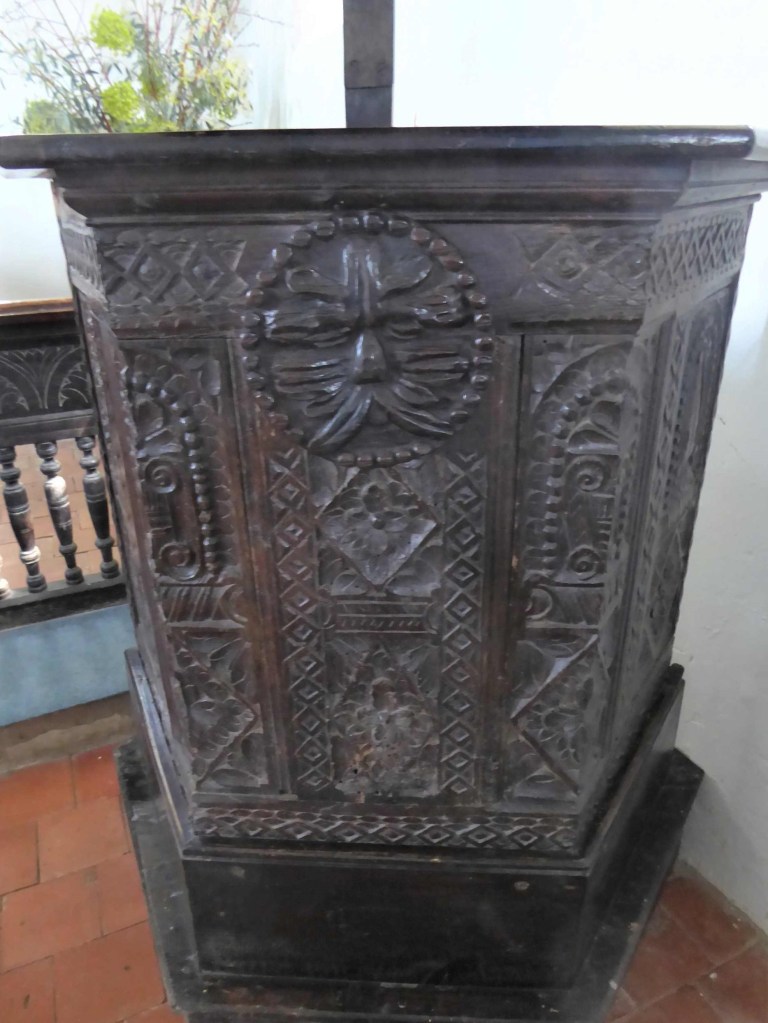
It looks Jacobean, and indeed was likely made out of an old Jacobean chest, by a later Rector. The more modern ‘Green Man’ carved disc on the front was added later, to disguise the keyhole on the front! Again, there’s no opportunity for a nervous preacher to hide – his flock is right there, within touching distance, and it seems quite possible that for many centuries there was no pulpit at all. Right at the back is the most modern addition – a tiny vestry. In centuries gone by, we can imagine the priest robing in the village and striding up to the church with his congregation.
Finally, look above your head. You’ll see the candle holders. Yes, you guessed it – electricity never made it this far and they still use candles, exactly as during the Middle Ages. There aren’t many churches left where this is still true and it speaks of the intimacy of St Andrew’s church – it really is like stepping back into a bygone era.
Places like St Andrew’s have been described as ‘thin’, meaning that God’s presence somehow feels nearer than in larger churches. Here there’s nothing to get in the way of feeling that you’re sharing God’s space; that God comes down to earth not just at Christmas in the form of the baby Jesus, but every day in this place that rejoices in its Christian atmosphere.
Worship, words and prayers come easily in such a place.
Please do say the words of ‘The Didling Prayer’ below before you leave. Thank your Heavenly Father for your blessings, but also for the way in which such places speak to us, and feed us through the centuries.
The Didling Prayer:
Loving Father, we praise and thank you for this tranquil place of worship which has witnessed to the Christian faith for many centuries. As the shepherds of old who tended their sheep on the Downs remembered the Great Shepherd of the Sheep, so may we too faithfully and lovingly fulfil your commands, remembering that we are also stewards of your great bounty. So, Lord, as we recollect with gratitude all those who have loved and served you here, we pray that, like St Andrew, we too may be worthy disciples and ever seek to proclaim in our lives the Good News of our Lord and Saviour Jesus Christ. Amen
Discover more from Reflective Preacher
Subscribe to get the latest posts sent to your email.
 Reflective Preacher
Lovely to read about this, James. I’ve been going there since you took me. Bit to catch up on when we next meet.
LikeLike
I have visited the church several times on trips to my natal West Sussex ( I live in Ottawa, Canada). The last time a harrier was gliding along the edges of an adjacent field, seeking a meal. Thank you for posting that delightful article.
LikeLike
Thank you for your generous comment. I wonder if you know Up Marden church? Not far away and when you visit it, you feel that you’ve stepped back hundreds of years!
LikeLike