15The Lord God took the man and put him in the garden of Eden to till it and look after it.
Genesis 2: 15 – The Revised English Bible
23And the land shall not be sold permanently, for the land is Mine, for you are strangers and sojourners with me. 24And throughout all the land of your possession you shall provide for a redemption of the land.
Leviticus 25: 23-24 – The Keys of the Kingdom Holy Bible
3They said to one another, ‘Come, let us make bricks and bake them hard’; they used bricks for stone and bitumen for mortar. 4Then they said, ‘Let us build ourselves a city and a tower with its top in the heavens and make a name for ourselves, or we shall be dispersed over the face of the earth.’
Genesis 11: 1-9 – The Revised English Bible
7But ask the beasts, and they will teach you; ask the birds of the air to inform you, 8or tell the creatures that crawl to teach you, and the fish of the sea to instruct you.
Job 12: 7-10 – The Revised English Bible
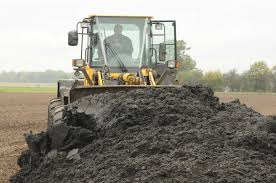
We’ve recently had a ‘delivery’ of sewage sludge to one of the fields very near to our house. Sewage sludge is also known as ‘biosolids’ and ‘humanure.’ It’s defined as the semisolid wastes left after the treatment of raw sewage in treatment plants. It’s important to stress that the waste that’s treated doesn’t just come from homes, but from industrial and chemical plants, abattoirs, hospitals and care homes etc. It’s all treated in the same way.
Each country makes its own rules about the use of sewage sludge on agricultural fields. In this country, we have a very easy-going approach to its use, underlined by the fact that we use 78.3% of the total sludge we produce in this way, whereas the average across the EU is only 38%. Several states in the USA have banned its use and it’s the subject of legal cases in several more. The US has been using sludge agriculturally for far longer than other countries, and some states have experienced cases of widespread illness and death. Other countries incinerate most and rarely approve its use in agriculture. Holland bans its use on agricultural land completely, which is one of the reasons why they are now exporting their sewage sludge to the UK – we imported some 200,000 tons of it from Holland last year. The position of the Dutch government is held, despite the active and enthusiastic encouragement of the EU to the spreading of sewage sludge on agricultural land.
Very few countries have been interested in analysing the sewage sludge, in order to find out what it contains. You can search widely for data relating to the UK; there’s hardly any available, at least not in an ‘official’ way. One of the reasons for this might be that enough has been done for the government to know for sure what would be found through analysis. As I write this, a Judicial Review is about to be considered in the High Court, following the Environment Agency’s decision to reverse a previous proposal to insist that sewage sludge is tested before it’s approved for use agriculturally.
The main treatment process is known as ‘anaerobic digestion.’ This is basically a process of encouraging bacteria to break the sludge down by pumping air into it. During this process, a bi-product is methane gas, which can be burnt to produce electricity. Some sewage treatment plants, such as those in the area in which I live, also use sterilisation by ultra-violet light and by composting. Older plants sometimes use lime.
There is a Code of Practice in the UK for its use. It includes the recommendation that the sludge should be turned into the ground ‘as soon as possible’ (it used to say ‘within 24 hours’ but that was removed when the Code was last revised). However, last year at the far end of the large field opposite our house, multiple truck loads of sludge were delivered in the spring, forming a pile 5 feet high, by 20 yards wide, by 100 yards long. The sludge remained there throughout the summer, and was only harrowed into the ground after the harvest, many months later. I’ve been unable to find out the truth of the rumour that farmers are actually being paid to take the sludge from the water companies.
So, what’s the problem?
The reasons that the EU and other governments give for encouraging sewage sludge to be spread on agricultural fields are that it’s a sustainable source of fertiliser; that it helps condition the soil and that it replaces nitrogen, which is derived from natural gas. I therefore need to underline that this whole issue is yet another one that is being driven by the race to Net Zero. As with other Net Zero issues such as electricity generation and electric vehicles, facts are simply not permitted to ‘get in the way’ of the Holy Grail of ‘Net Zero.’
The first and most obvious problem, certainly to anyone who lives close to its use, is the smell. Hang on, I hear proponents saying: ‘Surely if you live in the deepest countryside, you should have expected the occasional agricultural smell?’ Yes, of course. But this smell sticks in the back of the throat in a way that even the most offensive farm manure (generally agreed to be pig manure) doesn’t. Even after the manure has been harrowed in, the smell still lingers for several weeks, particularly if the weather is warm and dry.
But the smell is only the start. Even the UK government admits that sewage sludge contains ‘PTEs’ (Potentially Toxic Elements). It may be revealing that our government’s Health & Safety Executive demand that those working with sludge, or spreading it, must wear special respiratory protective equipment. It’s also worthy of note that this problem has only become an issue since the ‘Ocean Dumping Ban Act’ came into force in the USA in 1988, since when the volume put onto the land has rocketed, as ocean dumping has declined. So, it’s clearly agreed that it’s not safe to put it into the sea, but it may be safe to spread it within a few metres of people’s homes and gardens. The US National Research Council has stated that there is an issue with bioaerosols, meaning that people living or even passing along roads etc within one mile of sewage sludge, may be subject to ‘possible adverse health effects.’
So, what are these ‘potentially toxic elements’. I’m not a chemist, and data is (?deliberately?) scarce, but among the contaminants that have been found in various tests are these:
Heavy Metals: Silver, Chromium, Manganese, Antimony, Arsenic, Copper, Nickel, Cobalt, Zinc, Mercury, Cadmium, Molybdenum, Vanadium, Thallium, Titanium and Lead. Some of these have been known for many generations to be highly toxic, even in small concentrations. These metals make up approximately 0.5% to 2% of sewage sludge by weight. You will realise immediately that the waste treatment process cannot ever address these ‘PTEs’, nor do any current farming practices ever expect to deal with these contaminants, which studies have shown tend to accumulate in the soil.
Chemicals and Pharmaceuticals. More than 1,500 organic compounds and chemicals have been found in tests. These include pharmaceutical products such as antibiotics, hormones including progestin from contraceptive pills, lipid regulators, psychiatric drugs, anticoagulants, analgesics and endocrine-disruptors etc. Chemicals include Polycyclic aromatic hydrocarbon, polychlorinated biphenyl, perfluorinated surfactants, siloxanes, pesticides and phenols. Among the list of PTEs are many known carcinogens.
Although, as we’ve seen, the treatment process is mainly aimed at reducing pathogens, several pathogens including E-coli have been found in samples. It is claimed that it is free from COVID. I wonder how they know?
Finally, it’s worth mentioning Polyfluoroalkyl substances, often referred to as PFEs. These are referred to as the ‘Everlasting Chemicals’, as they accumulate in the soil and there is no known way of eliminating them.
All of these PTEs are found in sewage sludge that’s being spread on our fields. And the risk is not only to our food, via wheat, barley, oats and oilseed rape, but also these hazardous wastes are finding their way into our water supplies. I’ve recently tested my tap water for a large range of contaminants, and found to my horror that the tests for lead and Pesticides were both positive.
Among the very rare bits of research that have been carried out in the UK, was a study by the University of Aberdeen, in 2012. They monitored the health of sheep that had grazed on pastures that had been treated with sewage sludge a year earlier, and found there were high numbers of abnormalities in the subsequent lambs born from those sheep.
Whilst the spreading of sewage sludge has been going on quietly in the countryside without anyone noticing, there has been considerable concern about untreated sewage entering rivers and streams, at least in my area. I’m not saying this issue is unimportant, but it’s only a tiny part of the problem. But where is the main emphasis? It’s been on our activities releasing Carbon Dioxide into the atmosphere. This is an invisible gas, with no smell. What is the concentration of this gas in our atmosphere? It’s 0.042%, or four hundred and twenty parts per million! It’s also crucial plant food and most is generated naturally. 400 parts per million is one of the lowest concentrations in Earth’s history, and research clearly shows that CO2 rises after temperatures rise, rather than before.
So, while our world is fixated, paralysed and terrified of a small increase in this life-critical gas, no-one cares about the fact that we’re spreading dangerous substances directly into our food and water chains and in a way that is in all probability completely irreversible.
That’s why I say that all evidence points to us to facts that absolutely prove that we couldn’t care less about out environment; we only care about Net Zero.
It’s the very definition of madness.
This issue is very closely related to our health, which will be the topic of my next article. The issue that links the two, theologically, is the story of the ‘Tower of Babel’ which you can read about in Genesis 11:1-9. Not only does this describe the story of humans trying to challenge God, trying to outshine God, to make themselves God, but it’s also the story of our self-isolation from nature. We are beings that desperately need sunshine, clean air, uncontaminated water and food to flourish. When we ignore these, and instead claim that we’re affecting global weather by emitting Carbon Dioxide, we display a level of arrogance that is breathtaking.
Heavenly Father, forgive us for the way that we mistreat the earth, without which we have no life. Encourage us, we pray, to treat the land and water as your precious gift to future generations, and us as mere custodians. And grant us the ability to discern which problems we need to address and which result from our unforgivable arrogance. Amen
Discover more from Reflective Preacher
Subscribe to get the latest posts sent to your email.
 Reflective Preacher
Pingback: The facts show that we don’t care about our health! (Part Two) | Reflective Preacher