16b….Let the children come to me; do not try to stop them; for the kingdom of God belongs to such as these. 17Truly I tell you: whoever does not accept the kingdom of God like a child will never enter it
Luke 18: 16-17 – The Revised English Bible
4Whoever, therefore, abases himself like this little child is more eminent in the kingdom of the Exalted. 5And whoever will receive such a child in my name receives me. 6But as for whoever might cause offence to one of these little ones who believe in me, it would be more profitable for him that a millstone turned by a donkey should be hung around his neck, and he were drowned in the depth of the sea.
Luke 18: 4-6 – The Keys of the Kingdom Holy Bible
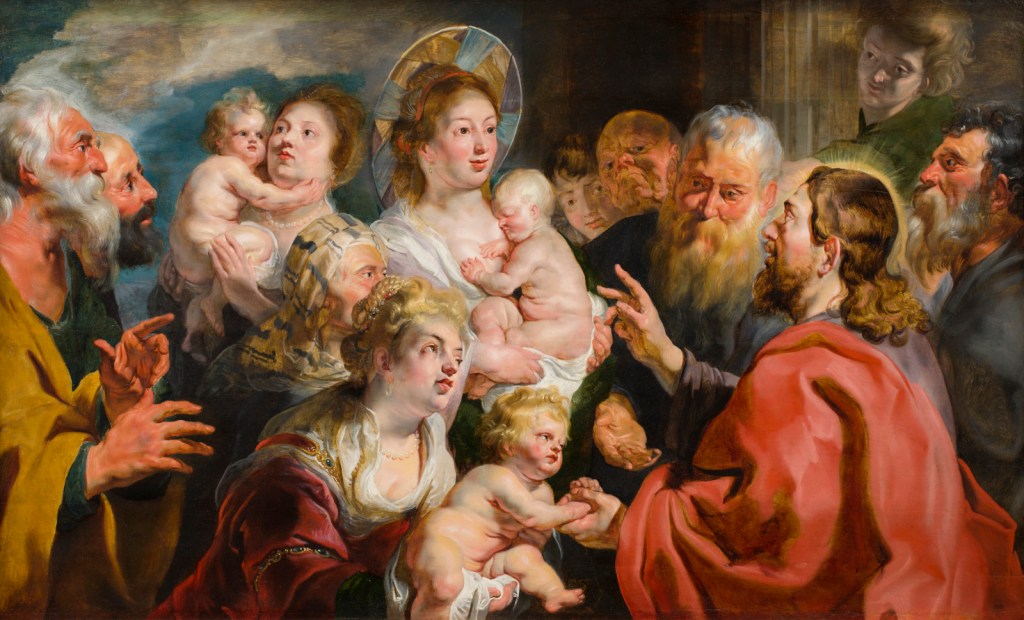
Picture courtesy of Saint Louis Art Museum
I’ve been steeling myself to write about the Huw Edwards story (for my overseas readers, he was the most senior BBC newsreader, who covered both the late Queen’s funeral and the Coronation of King Charles.) I find that the story of his being found in possession of pictures of sexual abuse and rape by adults of children as young as 7, to be so revolting that it makes me feel physically sick. But it’s one of the biggest stories of immorality of our time, and therefore can’t be ignored. His case came to a conclusion a couple of weeks ago. To my astonishment and utter horror, he was given a six month ‘suspended sentence.’ This means that he will not go to jail at all, unless he reoffends.
During the trial, the judge, Paul Goldspring, said this:
“…you are of previous good character, I accept positive exemplary character……It is obvious that until now you were very highly regarded by the public for your dedication and professionalism.’ He also said that if he sent Edwards to jail, his ‘suicide risk would be high and significant.’
So, you are of ‘exemplary character’ as long as you’re not actually caught abusing children? (I use the word abuse deliberately as, without the ‘users’ of such depraved material, there would be no abuse).
There’s more that needs to be said about this most disturbing of cases, but firstly I’d like to look at what the Bible might have to say about this, and what that might contribute to our understanding of the state of our once-great Nation.
I wonder what you make of the phrase in Luke’s gospel quoted above that: ‘whoever does not accept the kingdom of God as a child will never enter it’? I’ve heard many sermons over the years that have taken this short saying, and have ended up explaining exactly which aspect of being like a child that Jesus had in his mind, when he said this. What do we think of, when we think of what children are like? The kind of things that come to my mind are: innocent; humble; obedient; trustful; joyful; unselfconscious; receptive; wondering; mischievous; tolerant and maybe even resilient. All of these would seem to me to apply to children, and around each and every one (and any others you may think I’ve left out) you could build an eloquent sermon. After all, would it not be true to say that unless we trust in God’s providence, we can never receive the kingdom of God? But as so often when we bring ourselves into close proximity with an over-familiar passage from the Bible, it’s extremely difficult to put ourselves into the position of the first century audience and truly piece together exactly what Jesus meant by the phrase ‘like a child’. Of what aspect of childlikeness was he thinking? Our problem is that our society’s so distant from first century Palestine, that our pre-conditioning leads us down all sorts of incorrect paths. And what I want to suggest to you is that maybe Jesus didn’t mean any of the characteristics of children that I’ve just mentioned, but something that’s much less obvious.
I believe we may be misunderstanding the hierarchy of Jewish society if we think children had the same place in their society as they’re supposed to have in ours. We like to think of children as a gift; as demanding our nurture and protection; many of us would go so far as to consider our roles as parents as possibly the most important things that we ever undertake in adult life.
But despite the fact that we sometimes associate valuing children with Jewish family ideals, I think things were different in Jesus’ time and we kid ourselves if we believe children had an honoured place in society.
First of all, whether we like it or not, we have to accept that the birth of a girl, (as, shamefully, in some Middle and Asian societies even now), was greeted with sorrow in the time of Jesus, as women were considered inferior beings to men in every respect. There are some hints for us about the status of women in Mark Chapter 10: ‘Whoever divorces his wife and marries, commits adultery against her’, it’s easy to miss that this is new, revolutionary preaching from Jesus. In His world, husbands could divorce wives for any reason. Women could only divorce if they could convince a panel of male judges that they’d been neglected. A crime against a woman was considered a crime against the father or husband, not against the woman herself. So, men under the law could only be guilty of breaking the law about adultery against another man, not against a woman. So, when Jesus says ‘Whoever divorces his wife and marries, commits adultery against her,’ He’s at his most revolutionary, justice-led best.
In Jesus’ time, it’s likely that children weren’t valued in the way we like to think of them now. Even male children were the legal property of their fathers (note, not mothers). Perhaps if we’re as generous as we can be, we might say in mitigation that children very often had a poor life-expectancy, and because of that, parents had to be unsentimental. But the truth is that unwanted babies, particularly those from gentile families, were often dumped on rubbish heaps and if they were rescued at all, it was so that they could be sold into slavery. There was much infanticide (disgracefully, there still is), particularly of girl babies. Children had no rights, no value and no position in society. They only became of value when they were old enough to start work.
So, I think it’s fair to speculate that, when Jesus said that the kingdom of God belongs to small children, he was not referring to the fact that they were precious, special or loving. Rather, what he was saying was that they were absolutely without any status or value. In this sense, his teaching on children very much accords with the message that we read elsewhere in the gospels: prostitutes, the unclean, lepers, the destitute, women and, yes, children, are the ones that God is blessing and to whom he is holding out the promise of a better future, and he’s saying to his male disciples that they need to lose all status, all value, all social standing, all influence and all importance and worth, if they’re to receive the kingdom of God and be heirs to God’s promises. (For new readers who have not explored what the ‘Kingdom of God’ means, see these articles):
We can scarcely imagine how this message must have been received! We’ve come so far from the first century approach to the value of children, that maybe to bring the story to life, we need to consider who Jesus might have pointed to, to make his point in Britain in our time. To whom, in our country in 2024, does the kingdom of God belong? Perhaps to those I pass occasionally lying by the side of the pavement in London, sleeping in cardboard boxes? Or to those who have no job, no home, no friends, no money and no prospects? Probably all of these would have received Jesus’ compassion, but if we try to look at those with no influence or status at all, maybe we need look no further than the elderly, suffering from dementia in old-peoples’ homes? A few short years ago, I used to visit someone in such a place regularly, and although I had huge respect for, and trust in, those looking after the people there, I was acutely aware that if the residents had ever been mistreated, they had no voice to complain; no means by which they could express their pain; they were absolutely without value or worth in the sense that society normally defines such things. Like small children, such people are totally reliant on the compassion, love and goodwill of others. It’s partly because I’ve been close to such people that I’m instinctively wary about those who would like to change our laws to make it possible for people to sign up to have their lives terminated, despite the huge compassion I have, for those who’ve not lost their minds, but feel trapped in bodies that no longer function.
These elderly dementia sufferers are, I think, the people, and those like them, whom Jesus had in mind when he said that the kingdom of God belongs to little children. What he was saying was that we need to become like nobodies, like people with neither power nor status, if we’re to understand what he truly expects of his followers. It’s one of our Lord’s toughest and most uncompromising messages.
Returning to the Huw Edwards case, I find it incredible that the issue that the judge has used to defend his absolutely indefensible sentencing decision, is that Edwards was very highly regarded by the public. A lot has also been written about Edwards’ mental health. By which I imagine that to mean: ‘It’s had a bad effect on his mental health, being caught in possession of such depraved material.’ Suddenly, the perpetrator, disgracefully, becomes the victim.
There’s been a second case of this, only this week. Philip Schofield, yet another UK TV ‘celebrity’ who had an ‘affair’ with a 15-year-old boy (and hence is also guilty of paedophilia by definition) has blamed his colleagues of ‘throwing him under the bus’. Again, like Edwards, the perpetrator likes to portray himself as the victim.
It’s desperately sad to have relate this tale of our country inexorably slipping into depraved, perverted immorality, aided and abetted by a corrupt judiciary that has lost all touch with moral values. Child abuse is, apparently, now less worthy of a jail sentence than sending out an unwise social media post. We need to hang our heads in shame.
This is not the first time on this site that I’ve pointed out that the elimination of Christian values from our national life has led directly to us abandoning all moral values.
Jesus, in the above quotations from Luke’s gospel, calls for adults to abandon all their status, all their power and all their influence over others, all their social standing, all their perceived importance and worth, if they are to inherit the kingdom of God. And children are to be perceived as priceless, innocent beings who absolutely must be protected against the immorality of our perverted world, or the perpetrators will face drowning with a millstone around their necks. This is unusually uncompromising teaching from Jesus.
So, what do ‘the powers that be’ do, when faced with this teaching by Christ? They reverse it, so that power, influence, status and celebrity are the only characteristics that have value, and helpless children can be sacrificed at the altar of personality cults and reverse victimhood.
In closing, I can only quote Nicholas Creed:
“If humanity on the whole cannot or will not protect children from predators, then society has fallen.”
Heavenly Father, we must beg your forgiveness for the way in which we’ve rejected and perverted your values and teaching. Help us not only to repent, but to fight for the plight of those like innocent children, who are unable to fight for themselves. And help us, we pray, to see how empty and worthless are celebrity and status. Amen
Discover more from Reflective Preacher
Subscribe to get the latest posts sent to your email.
 Reflective Preacher