8Finally, brethren, whatsoever things are true, whatsoever things are honest, whatsoever things are just, whatsoever things are pure, whatsoever things are lovely, whatsoever things are of good report; if there be any virtue, and if there be any praise, think on these things.
Philippians 4:8 – The King James Bible
4It is to you I call, to all mankind I appeal: 5understand, you simpletons, what it is to be shrewd; you stupid people, understand what it is to have sense. 6Listen! For I shall speak clearly, you will have plain speech from me; 7for I speak nothing but truth, and my lips detest wicked talk. 8All that I say is right, not a word is twisted or crooked.
Proverbs 8: 3 – The Revised English Bible
3Indeed, children are a heritage from Yahweh, the fruit of the womb His reward.
Psalm 127: 3 – The Keys of the Kingdom Holy Bible
25On account of this, I say to you, do not be over-anxious about your life, what you will eat, or what you will drink, nor even about your body, what you will put on. Is life not more than food, and the body not more than clothing?
Matthew 6:25 – The Keys of the Kingdom Holy Bible
10For the love of money is a root of all the evils by which some, in their coveting, were seduced away from the faith, and they pierced themselves through with many sorrows. 11But you, oh man of God, flee these things, and follow after righteousness, godliness, faith, love, endurance, meekness.
1 Timothy 6:10-11 – The Keys of the Kingdom Holy Bible
Rupert David Charles Watts (‘Roo’) April 13th 1950 to December 8th 2024
I mentioned before Christmas that a close friend of mine, less than a year older than me, had died. His funeral was the most remarkable I’ve ever attended, and it’s left me wondering: What are the characteristics that sum up those whom the Bible describes as ‘living a life of good report’?
In case any of his friends or family read this, I’m not suggesting that anyone is perfect, and neither am I suggesting that I knew him better than his own close family. But there are features of some people’s personalities which mean that they are uniformly loved and admired. My friend was one of those. I’m left wondering whether those characteristics bear any relationship to Christianity. I don’t think you need to have met my friend in order to understand what follows, and you will, of course, be able to think of examples from your own experience of others.
Worry and Optimism
I’m sure my friend had his worries, but you’d never have known it. He lived life for the moment, and on the Order of Service for his funeral, it quoted one of his sayings that seemed so incredibly appropriate:
‘I’m here for a good time, not a long time.’
I hugely admire those who are able to take such a positive view of life and enjoy the minute; some people find that easier than others. My friend summed up optimism in a way that made those around him feel more positive.
Material Possessions and Money
Much of modern life seems to revolve around money and possessions; in fact, I meet people occasionally who seem to have no other thoughts or objectives. I know that we all need money to survive, but there’s something that’s admirable about those who are able to treat money with absolute disdain; such was my friend. I’m sure this occasionally drove his family mad, but it was a part of who he was, and it should lead us to reflect about whether too much of our own lives revolve around money and whether our own relationship with money is entirely healthy.
Family & Friends
All of us treasure our families, but for my friend, his family lay at the core of who he was. He came from a large Roman Catholic family and, as is often the case in my experience with such families, they are incredibly close – If you cut my friend in half, it said ‘Family’ right the way through. In addition, he would always give the impression to his friends when he spoke to them that at that moment, they were the only person in the world that mattered to him. His commitment was beyond loyalty as husband, father, grandfather, relative or friend. He was particularly generous in sharing his knowledge and his loves and he was a complete natural when it came to acting as a role model to small children. He also cared about his ‘wider’ family; in other words, his community and nation, as underlined by the choice of hymns at his funeral, which included ‘I vow to thee my country’ and ‘Jerusalem.’ He was one of those rare people who enjoyed the company of anyone and everyone.
‘WYSIWYG’
For younger people reading this who may never have come across this expression, it comes from the computer world. In the early days of Word Processors, users had to use extra characters to denote a new paragraph, etc. Eventually screens would show exactly what you would get when the document was printed, with no extraneous characters. They called it ‘What You See is What You Get,’ or WYSIWYG. My friend was exactly like that. He was as straight as a die; He was clear thinking and straight talking; you never had to try to double-guess him. As comes naturally to such ‘straight talking’ people, he rejected anything that was remotely ‘woke;’ he was not averse to acting in a way that others might have found embarrassing or awkward; it was all grist to his mill.
Nature and the Wild Places
In our modern world, a great deal is written and spoken about nature, but to my ears it often sounds a bit like worship of the Ancient Greek Goddess of the earth, GAIA. My friend lived his life with a deep love of and knowledge of countryside matters. He taught me a great deal and shared his passion with anyone who was interested; this included his passion for both shooting and, particularly, fishing. There is more than one generation which has learned to enjoy his love and to emulate his skills. My experience has been that people who love nature are often happier; closeness to nature reminds us of our place in God’s creation and experience of the ‘wild places’ on land or at sea, teaches us to respect and admire Mother Nature, in a way that’s hugely beneficial to our mental health. It’s an example of the phrase: ‘There’s something greater than us, of which we’re part.’
Enchanted by Beauty
My friend had an artist’s eye; his choice of career was to make his way as a professional photographer; a world in which he was highly respected. He could often see beauty in things that others couldn’t, which made his photos uniquely creative as well as expertly rendered. Of course, his skills were learned in a world where you had to understand and make decisions about light levels, aperture settings, shutter speeds, ISO, depth of field, framing, etc, etc. This is a world totally unknown to the modern digital generation; he was a true professional and something of a perfectionist; there were times when I admired one of his photos, only to hear him loudly criticise the features that he didn’t think were as good as he’d wanted.
Music
My friend and I both had a love of most types of music, and most of our evenings together involved sharing with each other something that one of us had discovered. His first love was of sacred music, which is also one of mine, as well as classical, jazz and much (but not all) ‘pop’ music. I’ve always felt that the happiest people are able to inspire themselves and others through music. The way that music speaks to us is a human characteristic that emphasises our consciousness; brain wave patterns can be captured on an EEG machine, but one of the mysteries of life is why some people are deeply moved by a piece of music that can leave others cold.
Belief and Philosophy
I’ve always been surprised by how many people pass through life without ever giving any thought to what the purpose is of their life on this planet. My friend was not an overtly ‘religious’ man, albeit he’d explored and been inspired by faith at an early stage in his life. But he was never a shallow man; he was practical, full of common sense (in a world that seems to have consciously abandoned that virtue); he knew what his beliefs were, he knew what mattered to him and others; he knew what was important and what was flummery. In short, he was at heart a philosophical man. And he had a faith; not in the worldly trappings of ‘churchiness’ and religiosity, but in a care for his God and for his fellow man. He had Christian values at the very centre of his life, but in a way that was absolutely unselfconscious.
Humility
The word ‘humility’ makes people shrink back in horror in our modern world; no one wishes to be seen as “ever so ‘umble.” But although he was a hugely ‘popular’ man, he never picked up the remotest hint of arrogance and self-righteousness that can sometimes grow in those who are popular. He shunned celebrity and scoffed at those who were pompous or smug. In that sense he was a witness to Christian humility, of a kind that’s now deeply out of fashion. If he’d needed to throw away all his dignity, in order to protect those in his care, he’d have rolled up his sleeves without a moment’s hesitation. I’ve seldom met anyone who was less inclined to stand on his own self-importance. He had a very rare combination of a huge, warm personality and a complete, almost self-effacing unselfishness.
Politeness and Generosity
My friend was both polite and generous. In fact, in terms of his friendship, he was generous to a fault. His instinct guided him to avoid saying anything that might be construed as cruel or heartless; he always saw the best in others. His was a huge personality with a gentle soul at its heart, which was why, I think, so many people were drawn to him.
Joy, humour and a sense of the ridiculous
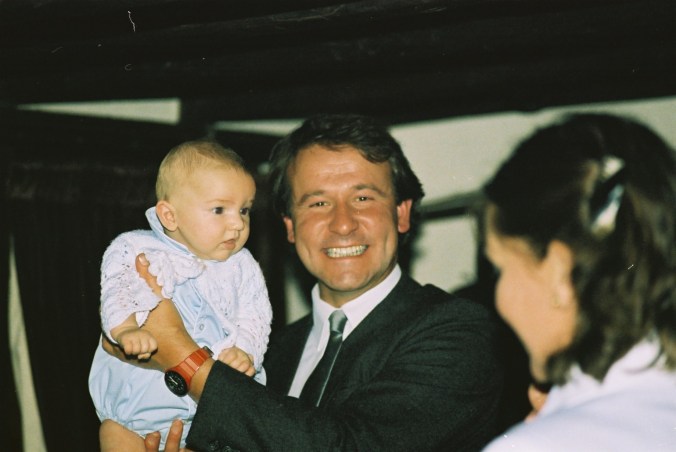
I’ve left my friend’s humour, charm and joy to the very end, although actually it’s the characteristic by which most of his friends will remember him. After his death, I honestly found it completely impossible to think of him without the huge warm grin that he carried everywhere with him. It summed him up so totally that it became impossible to think of him being serious or downcast; he lived every moment of life to the maximum and squeezed joy and laughter out of even the most unlikely scenarios. I hope that for those who never met him, the above photo, which I took at my second son’s Christening in 1985, will give some idea of the man. If I pause, I can hear his booming laugh and conjure up his beaming smile. Like many attractive personalities, some of his most hilarious stories were about himself; he had not the slightest discomfort in taking the mickey out of something silly that he’d done. He never took himself or the world too seriously. There’s a line in the famous poem ‘If’ by Rudyard Kipling that reflects his view of life:
‘If you can meet with Triumph and Disaster
And treat those two imposters just the same;’
Life was always fun around him; wild laughter followed him wherever he went and he made the most of every single moment of his life.
Summary
What does God want for us? For us Christians, we know that He loves us and, ultimately, that is why I believe that He wants us to share His love with others. If you add immeasurably to the pleasure and happiness of others, then you’re spreading God’s love around the world. That is why, as one of his close friends, he’ll not be forgotten, as he’s left behind so many wonderful and indelible memories, to sustain those of us who are left behind.
That is also why I believe, on reflection, that my friend was one of the most truly Christian men I’ve ever met. And why I can’t help but think that right now, he’s doing for heaven what he did for us here on earth, during his far too short life – making joy and laughter and happiness.
Heavenly Father, we give thanks for those who during their lives bring joy to others. Help us to emulate them in doing everything we can to share your love with the world. Amen
Discover more from Reflective Preacher
Subscribe to get the latest posts sent to your email.
 Reflective Preacher