13Now, as it happened, two of them were going on in that same day into a village called Emmaus, sixty stadium lengths distance from Jerusalem. 14And they were talking to each other concerning all these things that had taken place, 15and it came about, in their conversing and reasoning together, that Jesus, drawing himself near, walked along with them. 16But their eyes were restrained, so that they were not able to recognise him.
17And he said to them, ‘What are these words that you are exchanging with each other as you walk along and are downcast in countenance? 18And one them, named Cleopas, said in answer to him, ‘Are you a visitor alone to Jerusalem, yet you have not come to know the things having taken place in these days?’
19And he said to them, ‘What kind of things?’ and they said to him, ‘The things concerning Jesus the Nazarene, who was a man, a prophet, mighty in deed and word before God and all the people, 20and how the senior priests and our rulers delivered him to a sentence of death and crucified him. 21But we were hoping that he was the one who would redeem Israel, but then, besides all these things, today brings the third day from the time when all this took place. 22But also, certain women among us went early to the memorial tomb and they astounded us 23and, on their not finding his body, they came back saying as well that they had seen a vision of angels who say he is living. 24And some of those with us went to the memorial tomb, and they found it just as the women had also spoken, but they did not see him.’
25And he said to them, ‘Oh dullards, and slow of heart to believe in everything that the prophets have spoken! 26Ought the Christ not to have suffered these things, and to enter into his glory?’
27And beginning from Moses and from all the prophets, he gave them an exposition of all the things in the scrolls concerning himself.
28And they drew near to the village where they were heading, and he made out as if to be going further, 29but they constrained him, saying, ‘Stay with us, for it’s approaching evening, and the day has worn away.’
So he went in to stay with them. 30And it came about, in his sitting down with them, that having taken the loaf, he exalted God, and he broke it and handed some to them. 31And their eyes were opened and they recognised him and he became invisible to them
Luke 24: 13-31 – The Keys of the Kingdom Holy Bible
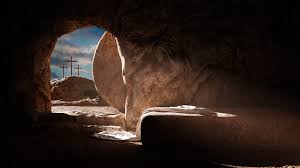
So far as Luke’s gospel in particular is concerned, Easter Day seems to be a very long day. It starts at what Luke calls ‘early dawn’, when the women who’d come with Jesus from Galilee and had stood at the foot of the cross just three days before, returned to the tomb and found it empty. They then returned to the apostles and told them what they’d seen and Luke tells us that their words seemed to the apostles like an ‘idle tale.’ The male apostles didn’t believe them; perhaps it was too much to expect; in first century Palestine, women weren’t permitted to give evidence in a Court of Law, their status was so lowly. But even so, the story is followed up by Peter going to the tomb to see for himself. He looks in and sees the empty tomb and Luke tells us that he was amazed at what had happened, although we’re not told that he sees an angel, or meets Jesus.
The story then switches to the one above, referred to as ‘The Road to Emmaus’, After this, the two travelling companions return to Jerusalem and speak to the apostles, who declare that the Lord has appeared to Simon Peter (although Luke doesn’t see fit to tell us exactly when and how this occurred). Immediately after this, Jesus appears amongst them all, shows them his hands and his feet, eats a piece of broiled fish and opens their minds to understand the scriptures. We could add in passing that for the Emmaus travelling companions, this is the second time that day that they’ve had the scriptures explained to them, the first time being by the unrecognised Jesus, as they’re walking to Emmaus.
Finally, and remember that according to Luke this all happens on Easter Day, Jesus tells them to stay in Jerusalem until they’ve been clothed with power from on high, and finally, at the end of an action-packed day, Jesus blesses them and ascends to his Father. To say that it’s a whirlwind day is an understatement.
I think we must feel pity for our two travellers on the road to Emmaus. It’s been a very long day, and in their case, the story makes it clear that they don’t have any rest, because as soon as Jesus appears to them, and just as promptly disappears, they make the return journey to Jerusalem, walking the seven return miles presumably during the night. So for them, in addition to all the other events, they have two seven-mile walks to make.
As if that wasn’t bad enough, their emotions must also have been like on a roller-coaster ride. They wake up on Easter morning, thinking that Jesus is dead and gone; they’re then told that he’s alive by the women. Then we read that as they’re walking to Emmaus, they’re sad, and finally they have the elation of seeing the risen Jesus and witnessing his Ascension. What on earth could they have made of it all, and how does it fit with our own slow, steady build-up over Holy Week in this last seven days, as we’ve commemorated the appalling events of Good Friday, the emptiness of Easter Saturday and the joy and alleluias of Easter Day? Are we also emotionally drained? Well, maybe not, but there is an expectation, is there not, that we will be able to follow the events; that our emotions can cope with the sadness of Good Friday converting into the opposite on Easter Day. And what if our emotions won’t play ball? What if this morning when we got up, we found it impossible to join in the joy? What if we genuinely couldn’t find any joy within our hearts? And what about tomorrow? We all know that the Christian season of Easter continues for more than five weeks, unlike the single day depicted in Luke’s gospel. Can we remain positive about our beliefs throughout that whole period? Can we feel uninterrupted joy for five weeks? What if within a few days, we find ourselves harbouring doubts about the resurrection? What if we harbour these doubts even before Easter Sunday is over? Does that condemn us as Christians?
Whatever you find it possible to think about the resurrection (and atheists would scoff at the possibility of not recognising someone close to you, to say nothing of the risen Jesus’s ability to appear and disappear) there’s great comfort in the gospel stories in the depiction that we find of Jesus’s closest followers. The centuries that followed the resurrection built these people up into holy figures, of gigantic stature and unshakeable faith. Thankfully, the pictures painted by the gospels, if anything, tend to underline their weakness and humanity. And this seems to be the case with this reading’s two travellers on the road to Emmaus.
If you were asked what your favourite Bible stories were, you may well, like many people, include this story of the Road to Emmaus. Why is this? It seems to me that it’s special partly because the story’s so vivid – it’s very easy to imagine ourselves in the scene – the dusty road, the stranger arriving in the midst of the two travelling companions – the interpretation of the Bible by this unknown companion who finally reveals his identity on the breaking of the bread and then promptly disappears. Who the travellers were, remains a mystery; we know only that from verse 18, one of them is called Cleopas. Cleopas may well be an alternative spelling to the name Clopas which appears in John 19, where Mary the wife of Clopas is listed among the women who stand at the foot of the cross on Good Friday. This leads to the intriguing possibility, believed by many, that the second person is Mary, and what we have here is a husband and wife, travelling away from Jerusalem in the afternoon of Easter Day, and maybe going back to their home in Emmaus, seven miles from Jerusalem. The other intriguing possibility is that Jesus arrives at the very moment when they’re having a husband and wifely tiff – this is implied by the Greek words that are rather gently translated ‘conversing and reasoning.’ The first word does indeed mean conversing, but the second word used could also be translated as ‘disputing.’ In verse 17, when Jesus asks them what they’re discussing, an alternative translation, so some scholars think, would be: ‘What are these words that you’re throwing against each other?’ This sounds much more like an argument than a discussion. We can only speculate what the row was about, but it’s easy, with this so wonderfully human little story, to believe that the clue might lie in the events at the tomb early that morning, when the women reported that the tomb was empty and the men thought it ‘an idle tale.’ It certainly seems possible that Clopas and his wife Mary were arguing about whether the testimony of the women at the empty tomb was trustworthy or not? If you add to the mix the fact that some Biblical scholars think that it’s likely that Mary the wife of Clopas was one of those at the empty tomb, then you most certainly have the makings of what the newspapers might describe as ‘a real ding-dong,’ with Cleopas maybe challenging what his wife thought she’d seen.
Into the middle of this disagreement or argument, Jesus steps. And he finds them not just arguing, but sad. How can they possibly be sad, we think? They’ve just been told that Jesus is alive. Like us, they can’t haul it in; it seems the opposite of what they think was promised in their sacred texts about the promised Messiah. And we read the crucial words that ‘But we were hoping that he was the one to redeem Israel.’ Were hoping. They’ve been through these events, but they still can’t believe. How does Jesus cope with this? Yes, he berates them for their slowness in believing. But he also does the only thing that’s going to help – he explains to them that the Messiah wasn’t prophesied to come to save Jews from suffering, but to save them through suffering. No wonder they found this hard to accept.
Later, the two travellers will look back at this and state ‘Was our heart not burning in us while he was talking with us on the road?’ But do they recognise Jesus at that point? No. Their hearts may indeed be burning, but still they don’t believe. They know about the resurrection, but still they WERE hoping and now they aren’t. How often are we like this, lurching from some hope to very little, to almost none and back to some…. The apostles on the Road to Emmaus have doubts. On Easter Day, we’re permitted our own doubts as well.
The travellers are attracted to their walking companion and although they don’t recognise him, he makes enough of an impression on them and turns just enough of their sadness and their arguing into hope, for them to invite him into what we assume to be their home in Emmaus. There Jesus takes bread, blesses and breaks it and gives it to them. And then their eyes are opened and they recognise him and believe.
In the words of one Biblical Scholar, it doesn’t matter if this story happened exactly as it’s described, because Emmaus ‘always happens.’ Emmaus happens again and again. It doesn’t matter whether we have doubts or not; it doesn’t matter if we feel sad at our own inability to have a consistent faith from day-to-day; it doesn’t matter if we squabble with each other over details of our faith. It doesn’t matter that we often fail to recognise that Jesus is with us on our own life journey; it doesn’t matter that moments of insight may be rare and for much of our lives we can’t see and find it hard to believe. Because, ultimately, what matters is that the risen Jesus offers to open up the meaning of scripture to us; the risen Jesus offers to make himself known to us through the breaking and sharing of the bread; the risen Jesus is there on our personal journeys and when we need it the most, even if we can’t recognise his presence. What we have to do is simply to open ourselves up to those possibilities, and if we can’t summon up the wherewithal to do that on Easter Day, tomorrow is another day, tomorrow presents us with another chance to witness the miracle, the incomprehensible miracle that is the risen Christ in our lives. Amen. Alleluia.
Risen Lord, strengthen our belief, we pray. But if we struggle to find joy today and every day, help us to be patient, until the day comes when you open our eyes and we finally recognise you as our Lord, our Saviour and our Redeemer. Amen
Discover more from Reflective Preacher
Subscribe to get the latest posts sent to your email.
 Reflective Preacher