5The light shines in the darkness and the darkness has never mastered it.
John 1:5 – The Revised English Bible
2….you yourselves know perfectly well that the day of the Lord comes like a thief in the night.
Thessalonians 1 5:2 – The Revised English Bible
12’but those who were born to the kingdom will be thrown out into the dark, where there will be wailing and grinding of teeth.’
Matthew 8: 12 – The Revised English Bible
15’The time has arrived; the kingdom of God is upon you. Repent and believe the gospel.
Mark 1:15 – The Revised English Bible
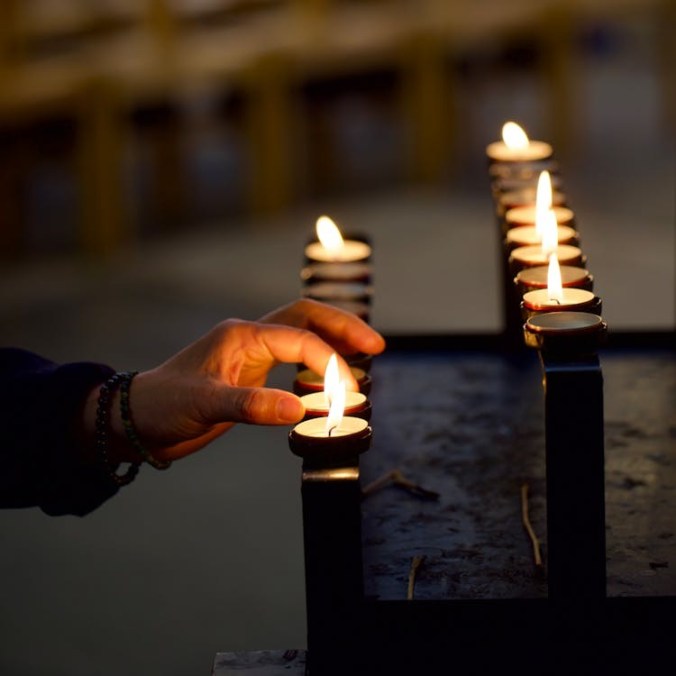
Photo courtesy Stephen Noulton/Pexels
I suspect that, like me, you’ve been appalled by the recent events in Sydney. It’s enough to have to confront innocent people being slaughtered by terrorists. Knowing that those terrorists have targeted those innocents because they are Jewish makes it incomprehensible. But when we also know that the barbaric monsters are claiming that they are acting to fulfil Allah’s wishes, then it shakes us to our core. And in our distress and our concern, it’s tempting in these situations to react in one of two ways: to look on and instantly wish for revenge. Or to say something along the lines of ‘On the Day of Judgement, the perpetrators will have to answer for their actions before God.’ But is the second of these two options any better or more acceptable than the first? Which is worse, to thirst for revenge for ourselves, or to warp God’s loving nature so much that we suggest that he’ll be happy to carry out our bloodthirsty revenge for us, and in the process provide people with a vision of a wrathful and violent God, little better than the ‘God’ on the lips of the mass murderers?
That these events happen during the time when we’re near to our shortest day, the weather is occasionally horrific and the shops are full of artificial ‘Christmas cheer’ and endless commercial tat, does not make it easier to understand or explain. But into this already complex mix, the Church of England, in its wisdom, adds weekly lectionary readings that include references to signs in the sun, distress among nations, people fainting from fear and foreboding of what’s coming upon the world; the powers of the heavens shaken. Where’s God’s love, promise joy and goodwill in this horrendous foretold apocalypse? No wonder Advent is a time of confusion for many.
If you try to discover what the Church of England orthodox interpretation of all this is, prepare to be disappointed; by and large the Church finds this difficult and studiously ignores it. And maybe we shouldn’t be surprised if, as a result, there are others around the world who’ve rushed to fill the gap with tales of judgement and burning lakes of sulphur for those who’ve not been close enough to their view of what should be the Christian ideal. And so, each year in Advent, we’re given readings with John the Baptist talking about the wrath to come; Paul writing about God coming like a thief in the night, and an Advent warning that we must be on our guard and be alert that when the Kingdom of God comes, that day should not catch us unexpectedly. And so, for the last few weeks, we’ve had swirling around us visions of the Last Judgment; Christ’s Second Coming; The Coming of the Kingdom of God; The Day of the Lord and, very soon, Christ will come to us on Christmas Day as a helpless baby. ….And slaughter in Australia.
The truth is that misunderstandings and popular culture have distorted out of all recognition some extremely important Christian teaching. In fact, perhaps the most important Christian teaching of all, because if you analyse everything that Jesus says in the Gospels, you can’t fail to reach the conclusion that he talks mainly about this one issue – the Coming of the Kingdom of God.
Ultimately, the reason that things become so muddled in Advent is because it’s easy to miss what the Gospels are actually saying about it. It’s the start of the process of the coming of God’s Kingdom – God come among us to herald the start of his Kingdom coming here on earth, ‘as it is in heaven.’ Much of the Church’s energy has gone into thinking about the ‘when’ of the full arrival of God’s kingdom. Jesus, according to Luke’s gospel, believed that it would arrive before the generation living with him had died. Instead, particularly during Advent, I believe our focus should be, not on the timing, which we can never know, but on what the coming of God’s Kingdom should mean – for us, for the world, for the Church and for the seemingly insoluble problems that crowd our news.
Jesus believed that you can’t divide the worship of God from the state of the world. That, for him as a first century rabbi, was an automatic assumption, but it’s less so for us. If you love and believe in God, Jesus says, then you also have to buy into God’s vision of the world as it ought to be, as he created it to be, as he intended it to be and as he longs for it to be.
And it’s impossible to believe in that vision, without also accepting that at the heart of it lies the love of God for each one of us – however flawed we may be, however wayward, however perverse, stubborn, brutal, barbaric or selfish. And if God loves us all that way, as we must believe as Christians, then we’re also called to see our fellow citizens in that same way – it’s the only way that God’s kingdom, God’s will, can ever possibly come on earth. Through coming on earth and suffering with us – in that cataclysmic event of the incarnation that we’ll all celebrate on Christmas Day – God shows us through the person of Jesus that we’re all created to have the loving relationship with him that Jesus showed was possible, and which ultimately holds the key to unlocking the transformation of the world. At the same time, for those of you who are now thinking that I’ve lost my mind, God gives us freewill, we are free to reject him totally; as the terrorists in Sydney have.
The apocalyptic vision of The Second Coming is not about the end of the world, as some speak of it, but rather about the beginning of the world as God intended it.
When I was in business, there was a great deal of talk about the needs for business leaders to provide a ‘vision’ for the people who worked for them. It was felt that without that vision, the organisation would fail to unite around a common desire, and in consequence pull in different directions and fail to perform.
I believe that our job as Christians, and never more so than at this time of year, is to set before others that vision of a world transformed; that vision of the coming of God’s Kingdom that ultimately every single person on this planet cries out for. Some might not call it that, but if you get them to describe what they want for the world, for themselves and for their children and loved ones, it’s that. A world where compassion and love enable them to begin to live together in peace and harmony with all; a world where they’re liberated from those things that imprison them: cruelty; injustice; discrimination; rejection; loneliness; war; violence; terrorism; the desire for revenge, and an insatiable appetite for more and more money, power over others and possessions.
But what are we to make of those who totally reject God’s vision? At least one Biblical expert, Nigel Moules, says that the process of bringing in God’s Kingdom ‘is disturbing because when relationships are bitter, broken and hostile, reconciliation will be traumatic, deeply painful and full of anguish. Phrases like ‘weeping and gnashing of teeth’ with images of darkness and a lake of fire aren’t about revenge or annihilation….but rather descriptions of the agony of having to accept responsibility for failure and harm, and the struggle towards authentic healing.’ Imagine if we were presented within a short space of time, with a continuous re-run of everything that we’d ever done that had hurt others, at any point in our lives; if we were transitioned through God’s love from being thick-skinned, selfish and lacking in conscience to suddenly becoming one of the most sensitive and conscience-ridden, for all our brutality and cruelty? It doesn’t really bear thinking about, does it?
At this time of year, with the daylight almost at its lowest, with the news full of depressing tales of our inhumanity to each other, it’s easy to allow negative thoughts to creep in. And if, as Christians we come with a message of hope in the midst of all this, we’re bound to be accused of showing hopeless optimism, of living in a utopian cloud-cuckoo land. Our faith calls us to be hopeful, and there’s an important difference between hope and optimism. Optimism puts a positive spin on things, but our Advent hope is a hope that recognises how bad things are, but goes on to propose that at the end of our preparation time – in a few short days – through the greatest, most hopeful and most inspiring event in the history of the world – God will come to us in the form of a helpless child and bring a piercing light to penetrate our darkness.
This, ultimately, is the nature of our hope and the stunning nature of the vision that we have to offer to a broken world. The world that we all want and which seems such a distant prospect is coming. An end to war, terror, hatred and suffering is coming. A world where all human beings are loved and respected not for what they have, but for what they are – the cherished children of God – is coming. An end to injustice and oppression, an end to the crushing of the powerless and vulnerable, is coming. The Kingdom of God is coming. How do we know? Because that’s the nature of our hope, our Christian hope, our Advent hope, as lived out and foretold by our Lord Jesus Christ. Advent is about preparing ourselves, and being ready and alert for that arrival, not in fear and foreboding, but in the blinding light of the certainty that that’s what we’ve been promised, even if we can never know the ‘when.’
Gracious and Heavenly Father, we thank you for the opportunity to thank you for your greatest gift, the birth of our Saviour Jesus Christ. Please shine your light this coming Christmas, even into the very darkest and most sinister places. Amen
And may I send all of you who are regular of irregular readers of my reflections, my very best wishes for a joyful and light-filled Christmas!
Discover more from Reflective Preacher
Subscribe to get the latest posts sent to your email.
 Reflective Preacher