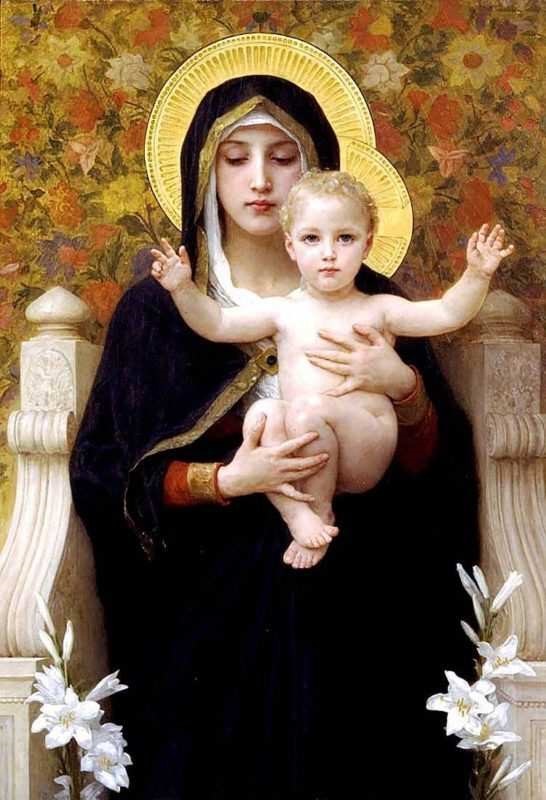
Madonna With Child by William-Adolphe Bouguereau, 1899
6The Lord said to Cain, ‘Why are you angry? Why are you scowling? If you do well, hold your head up; if not, sin is a demon crouching at the door; it will desire you, and you will be mastered by it.’
Genesis 4: 6-7 – Revised English Bible
18Pride goes before destruction and a haughty spirit before stumbling. 19Better to be of a lowly spirit with the poor than to divide the plunder with the proud.
Proverbs 16: 18-19: – The Keys of the Kingdom Holy Bible
1If then, there is any comfort in Christ, if any comfort of love, if any fellowship of spirit, if any tender compassions and mercies, 2make complete my exuberance by being of this same mind, having the same love, joined in mind, being mindful of the one thing, 3nothing being done for rivalry or groundless self-esteem, but by humility of mind esteem one another as surpassing yourselves.
Philippians 2: 1-3: – The Keys of the Kingdom Holy Bible
12And this will be a sign for you: You will find a baby wrapped in strips of cloth, lying in a feeding trough.’
Luke 2: 12 – The Keys of the Kingdom Holy Bible
A few weeks ago, I read a recent best seller: The Wager by David Grann. It tells the (true) story of a Royal Naval flotilla, of which HMS Wager was part, that was sent to the west coast of South America, via Cape Horn, and which resulted in the ship being wrecked off the coast of Chile. It tells the story of the subsequent dreadful sufferings of her crew and their struggles to find a way home. It’s a gripping tale, and I can recommend it on that level alone. But it also emphasises the importance of reading history, in order to understand how savage and brutal were the lives of our not-very-distant ancestors. The story starts in 1740, when my ancestor Jonathan Blott was 21 and living in Raunds in Northamptonshire – a mere six generations ago. The crew of The Wager found themselves wrecked on an uninhabited island, with no game and no edible plants, other than a few small wild celery plants. They were all dreadfully diseased with scurvy by the time they lost their ship and their only home and shelter. They were permanently cold, their clothes were in tatters and they had absolutely no chance of being rescued. Not surprisingly, discipline did not long survive such brutal conditions. Those members of the flotilla who eventually made it back to the UK numbered just 227 out of the more than 2,000 who had left the UK.
The book challenges us about how we would react, if we found ourselves in such a situation. The reading is not made more comfortable by the fact that these were the days of the Naval ‘press gangs’ and the ship was full of ‘thieves, housebreakers, Newgate Prison birds and the very filth of London.’ Many of those pressed managed to escape, necessitating their replacement by ‘the old, the lame, the sick and the limbless’. Some even had to be lifted onto the ship on stretchers.
1740 is of course a long time ago in the minds of most people. But I’ve also recently transcribed my mother’s memoirs, written before her death in 1994 and I’ve been shocked by some of the challenges that she faced, being evacuated from Baghdad in Iraq to Jerusalem, Egypt and South Africa just before the outbreak of World War 2, with two very small children in tow.
How can so many people think that they’re worse off than previous generations, despite the fact that there’s such a massive body of evidence that points in precisely the opposite direction? It’s a really challenging question. I explored it briefly in an article I wrote in 2020 that you can find here:
I don’t wish to be accused of belittling the problems that people face; I’ve often pointed out in these pages that I consider myself to have been exceptionally lucky and blessed. But I read routinely that our mental health as a nation is in a very poor state, and our health services can’t cope with the strain they’re under. Why is this, in an age when almost all of us are in a far better situation than our ancestors? Why, if you compare our position with those who had to earn a hard living on the land, and in a period before the invention of mechanical diggers, combine harvesters, powerful tractors, washing machines, cars and central heating? Do we now just take all these things for granted?
I need hardly stress that being born into abject poverty is a terrible thing, possibly made worse by the fact that we live constantly with all the excesses of the rich and famous in our faces, in a way that perhaps our ancestors didn’t?
But I wonder what they would have made of the fact that many people in our time actively wish to make themselves into victims? If being born an actual victim is terrible, what can or should we make of those of us who consciously, deliberately, in cold blood, wish to be seen as victims?
We see this all around us nearly every day. It’s almost as if people are actively seeking out a form of self-pity?
I’ve come to think that maybe in our world, making ourselves victims is a way of manipulating power over others: ‘You need to pay attention to my feelings and needs, as I’m helpless and can’t do anything for myself.’
It may also be a way of avoiding responsibility? If I’m a victim, then clearly, by definition, I can have had no part in the misery that I’m experiencing. Someone else, of necessity, must be responsible.
Maybe it’s also a form of jealousy? ‘I can see that others have far more than I have. It must therefore be their fault that I’m suffering.’
If there’s any truth in this analysis, then sadly it’s another example of the ‘God-shaped hole’ that has existed in people’s lives since society en masse decided to reject Christianity and belief in God. Making ourselves out to be victims is the precise opposite of believing that we’re one of God’s much-loved creatures.
The opposite of exercising power over others through victimhood is to embrace the fact that we’re all fragile, vulnerable creatures, needing help, love and support. This is true even, or perhaps particularly, if we disagree with them.
The opposite of focusing on ourselves and our needs is to make time to think of, and pray for, others. The more we concentrate on ourselves, the more miserable we become. Miraculously, prayer works the other way round, and makes those praying feel better about themselves.
You see, the problem with making ourselves victims, is that there is then a need to identify who is responsible for us becoming a victim. That then becomes the very antithesis of Christianity: ‘Search for those responsible, so that we know who to reject.’
The Christmas season invites us to consider our place in society, reflecting on the fact that God takes his place among us, in the form of that most helpless of human beings: a small defenceless baby. God becomes human by embracing our human vulnerability. By doing so, he demonstrates to us that we also need to embrace that same human vulnerability. It’s actually the only way that we can become fully human, as God intended us to be. It’s why the Christmas story is so powerful – through weakness comes perhaps the greatest strength of all.
So my prayer for everyone who reads this blog this Christmas is that we can all place the Christ-child at the centre of our celebrations, and embrace our own vulnerability as a symbol of God’s grace and love for us all.
Heavenly Father, help us to look upon the story of the stable and the manger this Christmas, and see our own vulnerability reflected there. And instead of focusing on our own needs and desires, help us to focus on the needs of others, acknowledging that, whoever we are, we’re all much-loved babies in your sight.
And I wish you all, and your loved-ones, the most blessed and joyful of Christmases!
Amen
Discover more from Reflective Preacher
Subscribe to get the latest posts sent to your email.
 Reflective Preacher
James this is all so very meaningful.As our world suffers it is hard to lose sight of hope but this Christmas tide is what it is all about,the infant Jesus born again amongst us reminding us all to live with Faith and therefore hope.
A happy and blessed Christmas to you and your Family.
LikeLike
Hi James.
Once again, you produce a wonderful thought provoking article.
Victim Hood is now a badge of honour and virtue that is celebrated.
Personal responsibility has been replaced by laziness and the blaming of others for one’s problems.
Christmas is a perfect time to reflect on the plight of Mary and Joseph and the struggle they faced and then the life and death of Jesus. No claims of victim Hood!
I have been reflecting on Mary these last few weeks and it amazes me in the current age that she us not held up as a wonderful example for women to look upto and use as a role model.
On another note, you should really consider recording readings of these articles and share them as a podcast. They would spread far and wide and be greatly relieved.
Take care!
LikeLike