6’Anyone who sheds human blood, for that human being his blood will be shed; because in the image of God has God made human beings
Genesis 9:6 – The Revised English Bible
13You shall not commit murder
Exodus 20:13 – The Keys of the Kingdom Holy Bible
12Whoever strikes another man and kills him must be put to death. 13But if he did not act with intent, but it came about by act of God, the slayer may flee to a place which I shall appoint for you. 14But if a man wilfully kills another by treachery, you are to take him even from my altar to be put to death.
Exodus 21:12-14 – The Revised English Bible
16By this we perceive love: in that he laid down his life for us, and we ought to lay down our lives for the brothers. 17But whoever might have the means of life of the world and sees his brother having need, but shuts up his pity from him, how could the love of God live in him?
1 John 3:16-17 – The Keys of the Kingdom Holy Bible
One of the things that’s distressing about getting older is that sometimes you can clearly see that major, hard-won lessons from the past are being thrown away recklessly. I was born not long after World War 2; my generation was appalled to learn that the Nazis had been killing the disabled, as well as ethnic Jews, Gypsies and other ‘undesirables’. On November 29th, the House of Commons may be about to turn their backs on this history, by introducing an ‘Assisted Dying’ Bill.
Before diving into this highly controversial and complex subject, I would like to make my own position clear, in the hope that it will encourage readers, on both sides of the debate, to read on. I don’t think that terminating someone’s life for compassionate reasons under certain circumstances, where the motive is entirely compassionate, should be illegal. But nor do I think that it should become an enshrined legally enforceable ‘right’ under UK law, for reasons that I’ll do my best to explain. An explanation of some of the main points of the discussion on both sides follows.
What does ‘Assisted Dying’ actually mean?
First of all, I believe that the publicity surrounding this subject has been misleading and the proposal, by Kim Leadbeater MP, in a Private Member’s Bill not yet published, is wrong to call itself an ‘Assisted Dying’ Bill. What it is, and words are important, is an Assisted Suicide Bill. I believe it is suggested that doctors would prescribe the drugs to end life, but the patient, applying for approval by two GPs and a Judge, would have to carry out the procedure themselves, without assistance and only after a diagnosis of being within six months of death (some sources say twelve months). The patient would also have to show mental capacity to make the decision, which implies some kind of psychiatric assessment, but again the details of how this would be carried out have not yet been revealed.
So, this is one of my first objections to the Bill as proposed. It would give the right to those who are both physically and mentally capable, of killing themselves, with the assistance of the medical fraternity. Those with loved-ones who’ve passed the point where they no longer recognise their nearest and dearest, would have to continue to watch in silence; the new Bill will not help them. This is one of the many reasons why the ‘slippery slope’ argument (which I explore below) is irrefutable. The relatives of those with dementia, or those with other conditions that meant that their loved one had insufficient mental or physical capacity to qualify, are already pressurising their MPs to widen the scope. Campaigns are calling for people with Parkinson’s Disease, Multiple Sclerosis, Senile Dementia or even ‘mental illness’ to be able to take advantage of any new legislation.
The ‘Slippery Slope’ argument
One of the main objections to this type of legislation is that it becomes a ‘slippery slope’, ie that it starts off being tightly controlled and is then gradually relaxed. This is precisely what happened to abortion legislation, where in 1967, 50,000 abortions were carried out. That figure is now in excess of 220,000; over one quarter of conceptions in England and Wales are now aborted. How many of these babies might have been capable of sustaining a healthy life? We don’t know, but what we do know is that was an important consideration in the 1967 legalisation of abortion.
Kim Leadbeater MP, who is proposing this legislation, says that there is no risk of a ‘slippery slope,’ but sadly in every jurisdiction, without exception, where the law has been changed to include some form of ‘Euthanasia,’ the original eligibility criteria have been relaxed over time. In the US state of Oregon, cited by Kim Leadbeater as an exemplar for rigorous and lasting safeguards, what started out as legislation meant only to cover the terminally ill, now permits patients with arthritis, anorexia nervosa, hernia and even ‘complications arising from a fall’ to be qualifying conditions. Canada, horrifically, is now actively considering extending their legislation to permit the mentally ill to apply for what they call ‘Medical Assistance in Dying’ (MAID, designed deliberately to sound like a cuddly piece of ‘home help’). And beware those who are canvassing for ‘6 months to live’ to be replaced by ‘six months of unbearable suffering’. Who’s going to define ‘unbearable suffering’? And how?
Where does the ‘slippery slope’ end? Very sadly, I’m far from alone in having lost much trust in the medical fraternity since the COVID debacle. One of the very strange aspects of modern life is that if, in 2020, you’d asked members of the public whether they trusted Boris Johnson, I fear you’d have had a very robust negative response. So why, when Boris said that it was necessary to lock down, mask up and be vaccinated, did such a huge percentage comply without question or hesitation? And in the light of recent events, I wonder how many people would trust the current government and the NHS not to start actively encouraging elderly patients to apply for ‘Assisted Dying,’ to free up hospital beds for those who were more ‘needy’? I think we all know, instinctively, that cost lies behind most of the big decisions taken by the NHS – why should this area be the only one to be exempt from cost pressures? We should also be considering the effect of this on palliative care. There are many specialists in this area, who feel that it is already seriously under-funded and needs many billions more pounds. Will there be pressure applied to reduce palliative care if a suitable, much cheaper, alternative is readily available?
‘My Death, My Decision’ (MDMD)
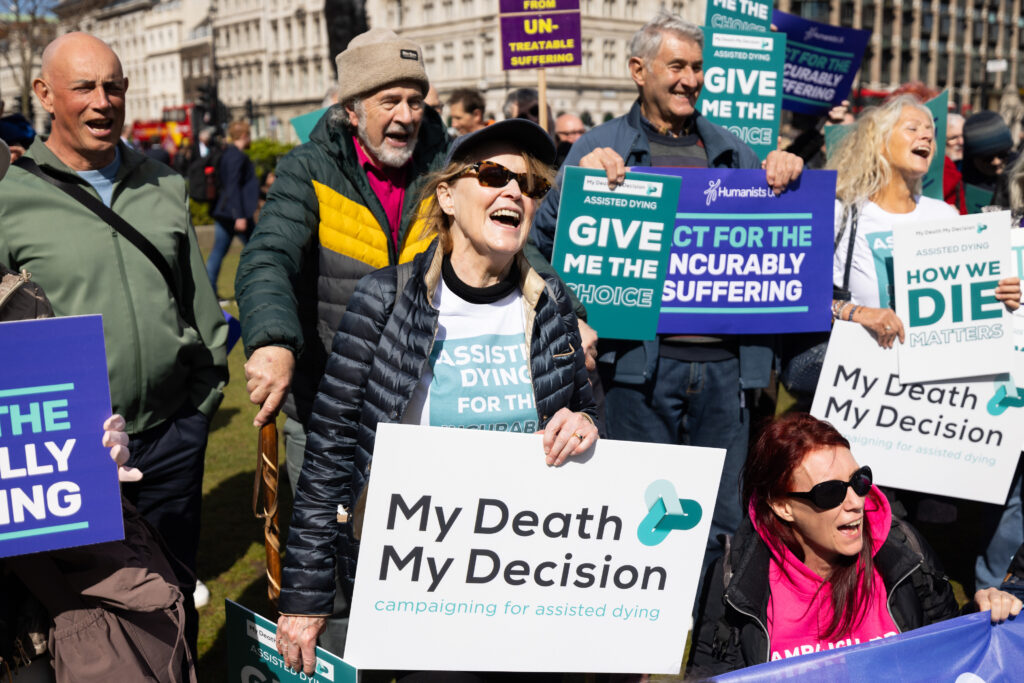
Photo courtesy of Andrew West
This is now the name of the leading campaign group for ‘Assisted Dying.’ It’s worth mentioning in passing that it’s not a registered charity and hence its sources of funding are totally opaque. It lists 17 staff on its website, including a ‘Director of Diversity’. What would this mean, in this context? Would the Director have to try to ensure that there the right balance of white, black and brown people qualifying to terminate their lives? MDMD is already campaigning for the ‘disabled’ to qualify. If the ‘disability’ in question meant that the patient could not self-administer the drugs (e.g. by having paralysis of the arms), the GP in question would have to do the deed and we would then move to ‘Assisted Killing.’ Are you worried yet? There is, believe me, a great deal more to be worried about.
The title ‘My Death, My Decision’ is selfishly arrogant, surely? If those applying have close friends and loved ones, are they not a crucial part of the decision? What should the two GPs and the Judge decide, if the patient wishes to terminate their life, but those surrounding them are not comfortable with their loved one’s decision? And how would any outsider be able to ensure that pressure had not been put on the patient, to apply for ‘Assisted Dying’? This is surely not possible; you would have to have a detailed understanding of the family dynamics?
Mental Illness and Dementia
For me, an absolute ‘red line’ would be to allow those suffering from mental illness or dementia to take their own lives; once you’ve agreed to this, what is the difference from the Nazis killing people with mental illnesses? And once you’ve removed from qualification all those who do not meet the mental and physical criteria, might we be changing the law in a potentially very dangerous way, for a tiny number of people? Those calling for the introduction of this legislation often refer to the ‘living death’ of senile dementia. We all know that is exactly what it can be, in the most distressing cases. But so far as I know, there is no possibility now of such people qualifying under the proposed legislation?
Effect of accuracy of a death prognosis
If you took a random set of GPs and asked them how confident they are of predicting death to within six months, I think you’d find the response would be near to zero. Which is another reason why the slippery slope will apply. There are precedents to back up this statement. One well-known case involved a baby called Tafida Raqeeb. Her mother was told that she had two weeks to live. Eventually, with a great deal of aggressive legal challenges from the medical establishment, Tafida was moved for special treatment to Italy, and is now almost 6 years old. Her mother says: ‘Medicine is not an exact science.’ If nothing else, COVID proved that, surely? The only relatively safe prognosis of death is within days, and even then, there have been many occasions when the prognosis has been entirely wrong.
And if those who are keen to avail themselves of this proposed legislation are nervous of the time limits, might it result in people terminating their lives much earlier than needed? Is this really what they and we want?
Effect on ‘Do Not Resuscitate’ (DNR) Orders
I suspect that many of my readers will have experienced having a loved one put onto the ‘Do Not Resuscitate’ list in a hospital, without either the patient or the family being consulted. For those who’ve not experienced this, my advice would be that every time you have a loved one who goes into hospital, make a point of ensuring that you ask for confirmation that they have not and will not be automatically added to such a list, without consultation. After the introduction of an ‘Assisted Dying’ Bill, the risks would surely increase?
“The law is a muddle, and that justifies the new proposed Bill”
It cannot be disputed that the law is a muddle.
Since 1961, suicide has not been illegal; this was a welcome change. However, assisting, aiding or counselling someone to kill themselves is, quite properly, still illegal, with a maximum penalty of 14 years in prison.
So, should we not be motivated by compassion, and allow people to make their own decision to end their lives, aided by friends and family, without fear of anyone being prosecuted?
My answer would be yes, in certain very clear and unambiguous cases. But although the law is certainly not crystal clear, history shows that this traditional British ‘muddle’ has been handled sympathetically and compassionately by the Police and the authorities. Making the law crystal clear and without muddle would, I fear, be in danger of adding a whole new layer of highly undesirable risks, because every single case is totally unique. Let’s look at some facts.
The official Criminal Prosecution Service Statistics show that between April 2009 and March 2024 (25 years) there have been 187 Assisted Suicide Cases referred to the Police. Of these, the CPS decided not to proceed with 126; the Police withdrew a further 36 cases, leaving 15 cases that have been pursued, in 25 years. The guidelines now dissuade prosecutions for assisting a loved one to commit suicide, if the motive is compassion. This, in my opinion, is entirely justified.
One case a while ago was brought as a ‘test case’ by a campaigner, who went out of their way to breach all the guidelines, including providing the ‘patient’ with a large cash payment, to incentivise them. Even so, Keir Starmer, who was Director of Public Prosecutions at the time, decided not to pursue the case. There’s no reason for anyone who’s genuinely helping a loved one out of compassion to feel that they have to fear the law; not one single person is now in prison for aiding a loved one, motivated by deep compassion.
Is it moral to encourage the vulnerable to see themselves as a burden?
If the option of ‘Assisted Dying’ becomes available, I think we can all think of the ways in which subtle and not-so-subtle pressure could be applied to those who are already in a vulnerable position? “My neighbour’s just been accepted for this. Don’t you think it’s something that will relieve your relatives of the worry of what will happen to you in months to come?” Those who see themselves as a burden (I have personal experience of someone who was in this situation) are generally invisible and their voices aren’t heard. The campaigners, in stark contrast, are loudly and clearly heard. Of course they are; they have big budgets, Communications and Public Affairs people, contacts in Parliament, etc. And they never give up. Lord Falconer has, on his own presented seven Bills on this subject to the House of Lords since 2014. All were defeated. If this latest attempt, this time in the House of Commons, is unsuccessful, it will be back within a couple of years, and the BBC has been a loud and consistent supporter of such a change for decades. I don’t know about you, but I don’t want our publicly-funded broadcaster campaigning on such a delicately balanced and deeply sensitive moral issue.
Would ‘Assisted Dying’ genuinely relieve people of pain and suffering?
Some years ago, there was a TV programme broadcast, called A short stay in Switzerland, telling the story of Dr Anne Turner’s visit with members of her family to the Dignitas clinic in Switzerland, which is happy to carry out Euthanasia, even for those with psychiatric conditions. After the film was broadcast, Dr Turner’s son said that the depiction of her death was not accurate; it had been less peaceful than implied.
In Oregon, there have been nine cases where people have been granted permission under their legislation, but have not died following the administration of the lethal drugs. Unsurprisingly, none of them returned for a second attempt. As proof that this is not as clear-cut as campaigners would like to suggest, those states in the USA that continue with the Death Penalty have frequently reported that neither drugs nor the electric chair are always effective. If the sole objective is the reduction of pain, should we not be concerned about this?
The key moral arguments
The ‘religious’ argument that drives some Christians is that life itself is God-given, and that we should not have the power to take to ourselves God’s sole right to remove life. My own position is rather more nuanced, not least because this argument is hardly effective for someone who has no faith. I feel that if I could be persuaded that introducing ‘Assisted Dying’ could be handled in a way that would not open others to coercive pressures, or other undesirable outcomes over the passage of time, then I would be in favour. My problem is that I’m not a fan of people assuming they know best, which almost always smacks of arrogance. And I’m no longer confident of those who write our legislation getting it right first time.
My starting point is that we should not underestimate the extent to which the public now sees death as a failure of medicine, rather than as an intrinsic part of life. What flows (or rather should) flow from that is that preparing for death is absolutely crucial, not just for those dying, but for those they’re leaving behind. It seems to me that growing older means that we should teach ourselves to embrace (or at least graciously accept) vulnerability and as a conscious act, let go of our modern obsession with being ‘in control.’ Accepting vulnerability is an important part of what it is to be human. Letting go of our ego and our control over ourselves is essential for us psychologically to prepare ourselves for death. Are people ever wrong about what’s in their own best interests? If people were never wrong, wouldn’t that make them omniscient? That’s what I mean by ‘Playing God.’ Are we actually entitled to expect a life without loss of control, without pain, without huge challenges and where everything can be decided by us, without consideration for others? Is it really a ‘human right’ to demand such things?
Shouldn’t everyone be prepared voluntarily to limit their own personal freedom and ‘human rights’, in order to protect the weak and vulnerable? Isn’t that what both our laws and our love for one another should be about?
How do we define ‘Quality of Life’?
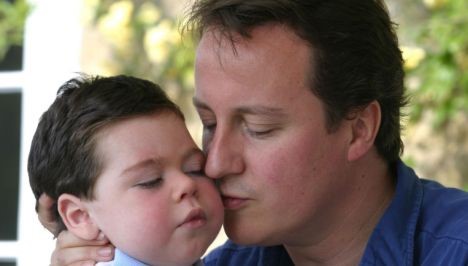
A great deal of the arguments in favour of ‘Assisted Dying’ refer to the loss of the ‘Quality of Life’, as we approach death. But I think this assumes a clarity of what actually is ‘Quality of Life’. That’s why I’ve used a photograph above of our ex-Prime Minister David Cameron’s late child, Ivan.
When his case was aired in the press, in February 2009, the Christian publication The Tablet said this:
“The meaning of the life of a six-year-old infant with cerebral palsy cannot be measured by intelligence tests or physical prowess. His measure is the deep love he received from those around him, stirred all the more by his hopeless vulnerability and the love he gave back.”
This quote explains why it is that I say that what is being proposed is the slippery slope to abandoning all moral values. There’s nothing that underpins morality more than our respect for the life and vulnerability of others. Which is why we should not be rushing into introducing legislation that legalises assisting suicide and which, with time, will almost certainly slip into the legalised killing of others. We must resist this, if we wish to continue to call ourselves a moral people!
Gracious, loving and merciful God, please guide those considering this massive change to our laws to consider what might happen, once we set off down this path. And we pray that those who govern us will be prepared to fight to the last breath to resist the ending of the lives of the mentally ill or those who are vulnerable, and those who feel that they are a burden to others. Amen
Post Script: The draft bill was published on 12th November. I haven’t yet read it, but a commentator said this:
“The Bill imposes an obligation on the NHS to ensure everyone has access to this great new service. … The Bill makes it legal for a doctor to suggest Assisted Suicide to a patient who hasn’t mentioned it (a common problem in cash-strapped health systems), but illegal for a doctor to refuse to refer someone for Assisted Suicide if they request it. No neutrality here.” (Danny Kruger MP)
In addition, a group of human rights barristers and legal scholars has warned that the proposal could breach the ECHR by denying some groups access to assisted death, while granting it to others, and will undoubtedly be challenged on discriminatory and equality grounds – but with a view to making euthanasia more easy, not more difficult. It seems that the ‘slippery slope’ has already started, even before the Bill has been debated and made law.
Discover more from Reflective Preacher
Subscribe to get the latest posts sent to your email.
 Reflective Preacher
Superb piece again, James.
LikeLike
Thanks for your generous comment, Chris.
LikeLike