23Be careful to know the state of your flock and take good care of your herds; 24for possessions do not last forever, nor will a crown endure to endless generations.
Proverbs 27:23-24 – The Revised English Bible
6In the morning sow your seed in good time, and do not let your hands slack off until evening, for you do not know whether this or that sowing will be successful, or whether both alike will do well.
Ecclesiastes 11:6 – The Revised English Bible
10When you have plenty to eat, bless the Lord your God for the good land he has given you.
Deuteronomy 8:10 – The Revised English Bible
21bHe said to them, ‘Then pay to Caesar what belongs to Caesar and to God what belongs to God.’
Matthew 22:21b – The Revised English Bible
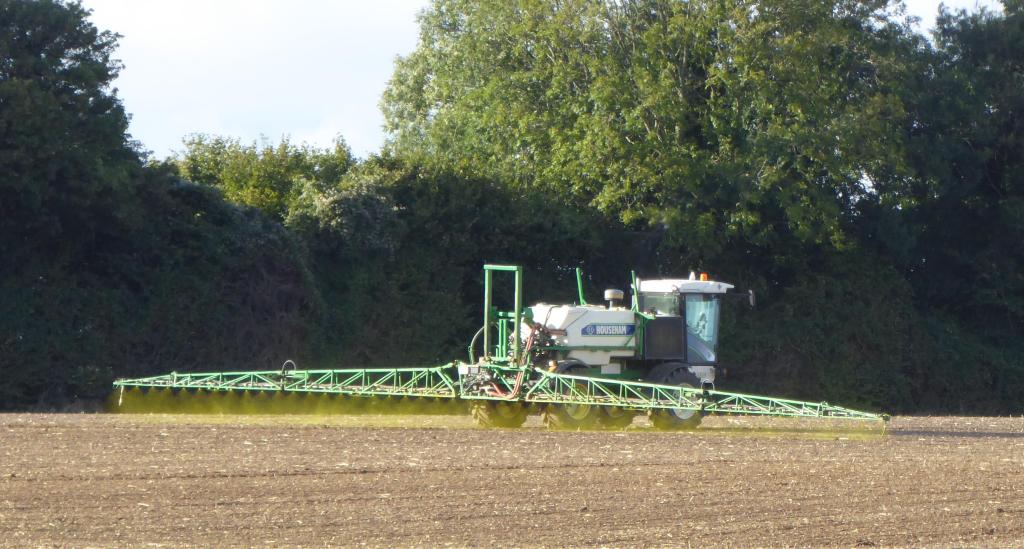
Photo by me in Sept 2016. What is the dayglo yellow spray?
OK, so I was born on a small farm of 49 acres in Essex. In the mid-1980s, I owned a very small sheep farm on the Welsh borders – 39 acres, 30 ewes and in a really good year, 75 lambs. That farm always consumed more money in fencing materials, than it ever earned. Luckily, I didn’t depend on the farm income for a living. But it was hard work.
With the exception of 3 years, when I lived and worked in London in the early 1970s, I’ve always lived in the countryside. Frankly, I adore the British countryside; I’d never want to live anywhere else, which is why I’ve never considered emigrating.
So, I was always likely to support the farmers in their complaints about the recently introduced Inheritance Tax.
But……. My problem is that I have a ‘But.’ Before I explore why this is the case, I would like to outline some of the very persuasive arguments for supporting the farmers, some of which haven’t been explored properly in the media. Then I’ll come back to my ‘But’.
Reasons for supporting the farmers
- I think, first of all, we need to accept that the passing of a farm from one generation to another does not entail a cash transaction; no money changes hands. So, the proposed tax is a tax on a ‘paper profit.’ Might this tax even be inflationary, by creating real money (tax) where none existed?
- Worse than that, as our Capital Gains are taxed in the UK, no allowance is made for inflation in value. I should know; not many years ago, a business in which I’d been an investor for over 40 years was sold (before you jump to conclusions, I’d taken out a second mortgage to buy my shares, when I’d worked for the company and had been ‘locked in’ when I left their employment, 12 years later) The resulting ‘gain’ on which I was taxed included a massive ‘gain,’ consisting of compound inflation over all those years. I was taxed at the full difference in value – I was paying Capital Gains Tax on illusory ‘gains’. So, I know what that feels like. So, how is the value of the farm being passed from parents to sons/daughters to be established for tax purposes, and what will be the additional costs of the tax authorities, of establishing this and agreeing it with the inheriting farmers?
- I hate to say this, but this does, I’m sorry to say, consist of Labour building walls between communities, between City and Country, as a deliberate policy. Farmers are viewed as ‘millionaires’ by many City folk, like the metropolitan elites who govern us. And some farmers are millionaires. It’s nonsense to suggest that all farmers are poor farmers, particularly in the grain-growing, lowland areas. There are plenty of ‘Grain Barons.’ If you don’t believe this, then you haven’t lived in such countryside. Is it really impossible for the tax authorities to sort the ‘wheat from the chaff’? No, it would be easy. That underlines the policy’s ideological roots. How would you feel if you were treated as a millionaire, but could not even afford to replace your 20-year-old, beaten-up car, or afford a holiday elsewhere in the UK?
- Agricultural land value is massively inflated when planning approval for housing etc is granted. This is nonsense. Such gains should be fully taxed, and should not affect average agricultural land values; when such gains occur, they should be treated as commercial profits. The value of a farm should be established in relation to its ability to create income. This has long been the case for the valuation of domestic housing. Again, the suggestion is that the farmers should pay for paper profits that don’t benefit the farmers. Why?
- During my lifetime, farmers have been screwed by the monolithic supermarkets. Look at the cost and price of a litre of milk, if you don’t believe me.
- When farmers, beset with ‘making ends meet’ have tried to create farm shops to diversify, they have often been stymied by ridiculous planning laws, designed to stop them, by the ‘Not in my back yard’ fraternity.
- Through our membership of the EU, regulations governing farms and farming have grown exponentially. The demand for paperwork is now completely out of control. Look at the regulations, for example, governing the tracking of livestock; I’ve become aware that this now requires farmers to put an identification tag in both ears of cattle. What bureaucrat decided on such madness?
- When health problems with animals have occurred on farms, the authorities have over-reacted in exactly the same way as they did over COVID. Over six million cows were slaughtered and buried in the 2001 Foot and Mouth outbreak. 4.4 million cattle were slaughtered and buried through the ‘Mad Cow Disease’ scare; there was a mass of evidence that this disease affected our European neighbours, who simply ignored it. Farmers’ lives were destroyed by regulators who’d never set foot on a farm, were unable to assess risk and didn’t understand, or even try to, about people’s financial or mental health.
- Local authorities have been trying to pass on their responsibilities for maintaining roads, verges and ditches through the notorious and ridiculous ‘riparian’ responsibilities to farms and farmers.
- Remote (often EU-based, even now!) regulators are busy banning chemicals on which farmers rely. I’m not saying that control of chemicals is not required; actually I would say the very opposite, but this makes it increasingly difficult to farm. A subcontractor of my local farmer has told me that if Glyphosate (Roundup) is ever banned as threatened, then the very large farm around us would have to be abandoned. I don’t know how to assess that statement, any more than I know how to arbitrate between those who wish to ban glyphosate and those who say that unless you swallow it, it’s safe.
- The cost of machinery has now become ridiculous. Have those suggesting that Inheritance Tax should now be set at £1 million, considered that a new Combine Harvester costs between £750,000 and £1 million? Unlikely. And with the push towards Net Zero becoming ever-greater, have they considered how fields will be farmed in years to come? ‘Just Stop Oil’? ‘Just Stop Farming and Just Stop Eating’, more like! If you’ve ever seen a tractor at work (cost of a tractor is from £80,000 to £200,000) you may think these people mad, as I do, to suggest that such machinery can be powered through electrical drives alone!
- In addition, the totally uncosted push for Net Zero has massively increased the cost of diesel and energy, both of which impact farming out of proportion to other sectors. And the increase in the cost of fertiliser (which is produced from hydrocarbons) has been stratospheric – the price more than doubled between 2020 and 2022.
- The general public are no longer treating farmland with respect. We often see people walking through the middle of the fields around us; they have no maps and no care for the damage they might do to the crops. Dogs can be out of control and often kill livestock. ‘Fly-tipping’ (the illegal tipping of household and industrial waste in the countryside) is an increasing problem – a couple of years ago, I counted 31 within a mile of where we live. And if the fly tips are onto the farmer’s property (even 5 feet off a footpath) then the farmer has to pay to have them removed.
- Farming is lonely, hard work, at anti-social hours, in difficult conditions (ever tried lambing in a snowstorm?) for a pitiful return. Not many of our fellow citizens would be prepared to tolerate it.
So, I have huge sympathy for farmers over this ideological attack on their livelihoods.
So why have I added a “But”?
As I’ve said, I’ve been a country-dweller all my life. And I’ve met many farmers, in many different areas. And I wish I could say that my experience of such contact has always been 100% positive. Sadly, it hasn’t. These are some of the things that I’ve experienced:
- Some farmers have no real feeling for the countryside; they view it as a factory manager would, looking at his factory. That is why, for example, so many ponds have been filled in, so many hedges and woods have been ripped out, in the name of production, over my lifetime.
- Some farmers care not a jot about the communities in which they live. About 70 years ago, there was a raised flint path that enabled my small community to walk to the local village, without getting their feet wet and muddy, for the Sunday church service. This community-created facility was pulled out and ploughed over with no-one’s permission in the 1950s, when the land was sold.
- Many of the butterflies, birds and wild flowers that were common in my youth now no longer exist or are exceedingly rare. Global warming? No, sorry, mostly changes in agricultural practices.
- Footpaths and Bridleways are supposed to be maintained by the farmers. The best farmers do this and should be congratulated. Some, sadly, make a point of making it as difficult for walkers as possible.
- When I lived in a different area in the 1980s and owned a thatched cottage, stubble-burning was common. Then the idea evolved that baling the straw was a waste of money, as no-one wanted the straw, so they took to burning everything, stubble and straw. One day, I found myself staring at a ten-foot-high wall of fire coming down the field towards my straw roof on a strong wind. I never received an apology; the farmer in question, like many others at the time, fought the legal banning of such practices ferociously; they had to be dragged, kicking and screaming, into a world where they accepted that their ‘industrial waste’ had to be disposed of sensibly, like that of every other business.
- The same farmer used aerial crop spraying, before that also became illegal. He took exception when I once complained of his spray dropping into my dogs’ bowls as they ate. He behaved as if it was his feudal right to do whatever he wanted. I’m happy to admit that far from all farmers are the same. But I’ve heard stories over the years of people having huge slurry tips (foul-smelling watery cow manure) placed next to their homes, as a protest against some small complaint about farming practices. That is why many country folk are very wary of talking out. Your local farmer can, quite legally, make your life unbearable.
- Mud on roads is inevitable. Many farmers do what they can to avoid it, or clean up afterwards. Many don’t. Many farming vehicles are exempt from Vehicle Excise Duty, but their vehicles are now so large and heavy that much damage is done to roads by those who don’t’ pay for their upkeep. Farmers get cheap (so-called red) diesel for their farm machinery; the price per litre is below half what others have to pay. Farmers are heavily dependent on diesel? Sure, so are transport companies, who are prohibited from using red diesel.
- Those of us who live in the countryside accept that we’re affected by what goes on around us. It should be ‘live and let live.’ But it would surely be nothing more than common courtesy to let neighbours know, on one of the hottest and driest days of the year, that the combine harvester is coming by, and please close your windows? If you’ve never seen it, you wouldn’t believe the volume of dust that is produced. Or ‘Maybe you should avoid walking near this field as we’ve sprayed it with something that might be a risk to you or your pet’s health’? I agree that if we’re talking here about a huge residential estate next to a field, it would be a problem. In our case, there are only five houses affected by the field behind and in front of us. A round-robin email would be perfectly adequate. I’ve included at the top of this blog a picture of a boom sprayer spreading something dayglo yellow on the field behind us in September 2016. I failed to find out what it was (maybe some kind of herbicide?) and whether it was likely to be a risk to our health.
- I’ve recently written about sewage sludge on this blogsite. There is never any warning of its arrival, and depending on how near it is, it can make your house almost uninhabitable from the smell, let alone the health risks. The ‘Code of Practice’ is almost entirely ignored.
- For many decades, farmers were exempt from having to apply for planning permission for agricultural buildings. We still have the legacy of this exemption, in some of the ugliest, poorest quality buildings still wrecking the landscape decades later. Why should farmers have been exempt? At the time, many MPs were land owners.
If there are any farmers reading this who’ve got this far, then I can hear them shouting:
So, you want to make life even harder for farmers?
No, that’s not the point. It is, of course, perfectly reasonable for you to ignore the feelings of your neighbours and communities, so long as you’re staying within the law.
But if you now want public support for your cause, then maybe you need to work a bit harder on your public relations?
There are some morals in the current tale about the taxing of family farms through Inheritance Tax. The main ones are these:
Morals:
- Real tax gains should be taxed when realised, at the same rate as everyone else. Unrealised gains should not be taxed, nor should inflationary illusory ‘gains’.
- Once upon a time, Conservatives used to build a solid economy. Labour then took it over and wrecked it through tax and spend. This time, the Conservative/Lib Dem coalition and then the Ultra-Liberal “Conservatives” wrecked the economy through almost unlimited tax and spend. And Labour? They’re of course following the same path, but at breakneck speed, as we’ve already seen. The result will be national bankruptcy, but in double-quick time. It’s been pointed out elsewhere that the IHT tax on farm inheritance will raise as much as 2 COVID enquiries and 1 HS2 ‘bat shed’. Is it genuinely worth pursuing financially, or is the point an ideological one?
- The EU ‘Common Agricultural Policy’ was completely mad and on its own was a powerful argument for Brexit. It gave subsidies per ton of the subsidised product being grown and sold. This was done to support poor French farmers with very small farms. The unwanted side-effect was that the bigger your farm, the bigger the subsidies became. The sums were enormous for the ‘Grain Barons.’ In 2016, The Newmarket farm of Khalid Abdullah al Saud, the late second son of the King of Saudi Arabia, was among the top 100 recipients of EU farm grants in the UK, totalling an eye watering £3.6 million in just one year – just under £5 million in 2024 values. Our Agricultural Ministry, DEFRA, chose not to diverge from these mad CAP (pun intended) policies after Brexit, so we’re now getting the worst of all possible worlds.
- Because of the EU and post Brexit subsidies, the richer farmers will get richer. The poorer farmers will get poorer. The richest farmers have the best Tax Advisors and will most likely not be affected by our Socialist government’s new taxes. The poorer ones will, and will be hugely damaged. Is that really what this Labour government wants?
- Inheritance Tax is dishonest and should not exist. If you pay Income Tax throughout your life, pay VAT whenever you buy something and then pay the highest rate of Capital Gains when you retire and sell your business, your remaining estate then gets clobbered by IHT. This is tax upon tax upon tax. None of us would object so much to this, if we were getting good value out of government expenditure. But we know that we aren’t. Is this increase in tax to farmers really needed? We all know that waste in the public sector is mind-boggling. If this government, any government, brought waste under control, they would find much less pushback against extending tax policies. But neither ‘cheek’ of the ‘Uniparty’ is seriously suggesting cutting back on public expenditure. And to pay for it, they’re victimising those they have made their enemies in the countryside.
But
- If the farmers are to get the public behind them, they need to become less arrogant, less like the successors of the feudal barons and start addressing some of the perfectly reasonable wishes of their immediate neighbours and communities. The alternative doesn’t bear thinking about.
Post Script
As I write this, there are strong rumours that Starmer is going to back off his policy. I’ve decided to publish this anyway, as I think there are some important ‘points of principle’ included in this debate.
Oh, and by the way, the quotation from Matthew 22 shown above; the famous ‘Render to Caesar’ saying, is Jesus at his most revolutionary – what he meant was that everything belongs to God!
Gracious and loving God, bless those who work hard to supply our food and who are often under huge stress. Let those of us who are not farmers appreciate their efforts. And help to guide farmers to treat their communities as their equals in the struggle to look after your beautiful countryside. Amen
Discover more from Reflective Preacher
Subscribe to get the latest posts sent to your email.
 Reflective Preacher
That was a great synopsys of what’s going on in the Briyish countryside, thank you! Are there parallels with the strange land-grabbing situation that we were seeing in The Netherlands recently (and which may still be going on for all I know)?
LikeLike
Thanks, I’m not as informed of the situation in the Netherlands. But I believe they have much lower energy costs, which have resulted in them being much greater exporters, the largest food exporters in Europe? Maybe I’m wrong about that? And I believe they use a lot of CO2 in their food production, to make bigger crops? If anyone here knows that’s wrong, please comment.
LikeLike
p.s. My name is not Max Glassburg … not sure how that got there …
LikeLike
Sorry, don’t understand this, I’ve not experienced this before
LikeLike
Maybe better to delete these comments under somenody else’s name, please.
LikeLike
Sorry, Sir, I don’t understand what happened here. Did you not make that comment that I just replied to?
LikeLike
I totally agree. I shared with a friend with whom I jad been discussing this very matter.
LikeLike