11 Again, he said: ‘There was once a man who had two sons; 12and the younger said to his father, “Father, give me my share of the property .” So he divided his estate between them. 13A few days later the younger son turned the whole of his share into cash and left home for a distant country, where he squandered it in dissolute living. 14He had spent it all, when a severe famine fell upon that country, and he began to be in need. 15So he went and attached himself to one of the local landowners, who sent him into his farm to mind the pigs. 16He would have been glad to have filled his belly with the pods that the pigs were eating; but no one gave him anything. 17Then he came to his senses: “How many of my father’s hired servants have more food than they can eat,” he said, “and here am I starving to death! 18I will go at once to my father, and say to him, ‘Father, I have sinned against God and against you; 19I am no longer fit to be called your son; treat me as one of your hired servants.’ ” 20So he set out for his father’s house. But while he was still a long way off his father saw him, and his heart went out to him; he ran to meet him, flung his arms around him, and kissed him. 21The son said, “Father, I have sinned against God and against you; I am no longer fit to be called your son.” 22But the father said to his servants, “Quick! Fetch a robe, the best we have and put it on him; put a ring on his finger and sandals on his feet. 23Bring the fatted calf and kill it, and let us celebrate with a feast; 24for this son of mine was dead and has come back to life; he was lost and is found!” And the festivities began.
25 ‘Now the elder son had been out on the farm; and on his way back, as he approached the house, he heard music and dancing. 26He called one of the servants and asked what it meant. 27The servant told him, “Your brother has come home, and your father has killed the fatted calf, because he has him back safe and sound.” 28But he was angry and refused to go in. His father came out and pleaded with him; 29but he retorted, “You know how I have slaved for you all these years; I never once disobeyed your orders; yet you never gave me so much as a kid, to celebrate with my friends.30But now that this son of yours turns up, after running through your money with his women, you kill the fatted calf for him” 31“My boy,” said the father, “you are always with me, and everything I have is yours. 32How could we fail to celebrate this happy day? Your brother here was dead and has come back to life; he was lost and has been found.”‘
Luke 15:11-32 – The Revised English Bible
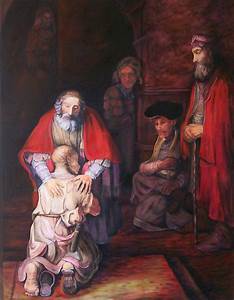
In February 2019, I was lucky enough to enjoy a visit to St Petersburg with a number of friends; at the time we had no idea that a mere three years later, such a trip would have become impossible, as a result of the start of the Ukraine war. I knew that Rembrandt’s famous painting ‘The Return of the Prodigal Son’ was hung in the Hermitage Museum in St Petersburg and I was incredibly lucky to be allowed to stand in front of the painting for 15 minutes, on a day when the Museum was closed to the public.
In 2016, I had read The Return of the Prodigal Son by Henri Nouwen, which considers the effect of the painting on the author’s life. It also had a big impact on me, albeit not in a life-changing way. I first preached on this bible passage just over a year later, in the magnificent surroundings of the Royal Naval College Chapel in Greenwich, when my friend The Revd Pat Mann was kind enough to invite me to preach on any passage I wished. A short version of that sermon appeared on this blog, in May 2019 under the heading ‘What is God’s true nature?’ As I’ve mentioned often on this blog, I’ve often found that my biblical reflections change and develop with time and this has been so true of St Luke’s wonderful story of The Prodigal Son, which I keep coming back to. It’s for that reason that I think it’s worth updating and adding to my last thoughts, as there is so much more to say.
I propose to start this blog with an interpretation of the painting, then give an interpretation of the biblical passage and end with some additional comments on how the story has affected our Christian message over the centuries.
Rembrandt’s painting.
Rembrandt almost certainly saw himself as the younger, so-called ‘prodigal son’ in the story. Many people don’t know what the word ‘prodigal’ means; probably the single word that’s nearest in English is ‘wastrel’, but it takes in so much more than simple extravagance. What follows will, I hope, give you a better idea of the breadth of ideas meant by St Luke. Rembrandt completed his painting when he was near to death, at the end of what he knew to have been a wasteful life; he was bankrupt despite being a successful artist; his wife, a son and two daughters had died and he was contemplating the wrong turns that he had taken throughout his own life.
The painting, it must be emphasised, does not describe the whole biblical story, which is why this blog covers not just the painting but the verses from St Luke. The painting is, rather, a snapshot of all the things that were important to the artist. It is, in fact, two paintings merged into one – the figures on the right including the figure of the Prodigal’s older brother and two ‘bystanders’ do not witness the biblical greeting of the Prodigal by his father in St Luke. The biblical scene of the father greeting his prodigal son on the left of the painting takes place in the open, when the two figures are on their own. But the amalgamation of these two scenes gives life to several other parts of the story.
The painting is quite dark. This is deliberate by Rembrandt, as it gives him the opportunity to show the father’s forehead as the source of all light for the rest of the painting. The father leans forward towards the prodigal, whereas the older brother not only stands erect, taut and haughty but is also separated from the father by what looks like a step; he looks down on his father and younger brother not just literally, but metaphorically. His face conveys unhappiness, resentment, anger and judgement of his brother, whereas the father’s face is all love, tolerance and acceptance. These aspects of the painting are deeply challenging to us all, which is why many commentators feel that we need to see ourselves as a mixture of both sons. The seated figure with a hat, to the left of the older brother ,is thought to have been a self-portrait by Rembrandt, involving himself in the scene as his own personal act of contrition. The very dark figure behind and to his right possibly is meant as a representation of the community, showing complete disdain for both father and son. This underlines the loss of dignity that the father is enthusiastically embracing in his outward display of love for his wayward son, who has done so much deliberately to hurt him.
The father’s face is a perfect depiction of love; some commentators have even suggested that he looks as though he has been no stranger to tears, since his prodigal left.
The father’s hands have been the subject of much interpretation. Not only do they straddle a huge hole in his son’s shirt, but the left hand looks masculine, whereas the right looks much more delicate and feminine; is the artist trying to convey to us that God is neither masculine nor feminine, but has the characteristics of both? That would seem quite likely, and I find that idea helpful.
The prodigal’s face is not visible to us. His clothes are a metaphor for what has happened to his life and social position. They are in tatters, as is his soul. The lack of wearable shoes is significant. In antiquity, shoes were a sign of standing and social position. The prodigal’s left shoe is unwearable; the right is almost the same, with the heel missing completely. Walking barefoot was a sign of slavery and destitution. To this day in parts of the Middle East, shoes carry a huge significance, which is why the crowd in Baghdad removed their shoes to beat the statue of Saddam Hussein with, after he was toppled and why, when you visit the Middle East, you are advised never to show the soles of your shoes to your hosts, as it represents a serious insult. Shoes have to be removed when entering mosques, to show that everyone is equal before God. Even sandals were luxury items in the first century. The state of the prodigal’s scarred feet underlines the fact that he is quite literally ‘on his uppers’ both physically and, because what’s left of the shoes are on the wrong feet, mentally too.
A shaved head in antiquity was also a sign of servitude, possibly because of the risk of catching a disease from a destitute person? Shaving the head or beard was often imposed as an act of public humiliation, subjugation, or divine judgment against defeated or disobedient populations. We are reminded of the biblical story of the cutting of Samson’s hair by Delilah.
Henri Nouwen himself felt that the prodigal’s head looked like that of a new born baby, underlining that the prodigal is about to be reborn into a different world. The father’s chest is placed where a new born would suckle, in yet another sign of God’s femininity and the prodigal’s rebirth.
But now I must turn my attention to the story that Luke writes in Luke 15:11-32, as there is so much more to explore via the words.
The Bible Passage
Because it’s so well-known, there are real risks that we switch off when listening to a reading of this passage, thinking: ‘Oh yes, the Prodigal Son again’, but one of my objectives in this blog is to encourage us to open ourselves up to hearing this story in a new way, to strain to hear it as those for whom it was first told heard it, however challenging that might be and however huge is the cultural and historic gulf between us and Jesus’s first audience.
We need, for example, to imagine the sharp intake of breath from Jesus’s first hearers, when they heard the sentence spoken by the younger son: ‘Father, give me my share of the property.’ Experts in Middle Eastern culture have pointed out that this can only really mean one thing – that the son is impatient for the death of his father. The phrase would have been absolutely shocking, and is worded brutally – ‘give me’. Theologically, the equivalent in our era is that this is mankind wanting God dead. In the story, the father agrees to his younger son’s disgraceful demands, and then the younger son sells half his father’s assets built up over a lifetime, in a few days, by means of a fire sale that would again have been truly shocking. Immediately afterwards, the son abandons his father, family, community, everything, taking the cash with him. And we need to grasp that he chooses in cold blood to wound his father and cut off all ties with his family and the wider community. He shows his father and all the others that he simply doesn’t care about them. We’re so used to young people travelling long distances in our day and age, that the story’s lost its power to shock us, but in the first century, there was a high risk that the son would never return alive, as travelling was so dangerous. The father no doubt is distraught at this; the son just doesn’t care how his father feels. The son demands privilege without responsibility. The father, in stark contrast, grants his son the freedom to reject him, and although he’s deeply hurt by his son, he doesn’t love him any less because of the selfish way that he’s behaved. This, on its own, is a great reason for reflecting more deeply on this story.
The son then travels to Gentile lands, which we know because they’re keepers of pigs. Again, more shock; that the son of a respected Jewish patriarch would have chosen to go and live among those viewed by the Jews as the savage and uncivilised gentiles. A modern Biblical scholar has compared how first century Jews viewed the eating of pork, with how we’d react in our day to someone who ate cockroaches. But when the son’s squandered his entire inheritance and comes to his senses, he decides that he’ll go and ask his father to treat him as one of his hired servants. Through this we know that he still doesn’t quite get it, even when he’s on his uppers. There’s no repentance implied in the words in this part of the story; he finds himself hungry and thinks of a way that he can go back into the community and still retain some standing and self-respect. It’s all about him; he doesn’t understand that the real issue isn’t about him, nor is it about the lost money. What it’s about is that he’s chosen, quite deliberately, to break his father’s heart and treat his relationship with the family and community as if it didn’t matter. No wonder the reaction of the older brother is as it is described, with him using the phrase to his father ‘this son of yours’ and ‘I have slaved for you’. He’s outraged; he reacts the very way that we think the father should.
And so, we move forward to what I want to persuade you is the most important part of the story, and one for which the true meaning has become blurred: the response of the Father to these events. For here lies an astonishing story about the nature of God; here’s the part of the story that helps us to answer the question: ‘What is God’s nature?’
We read that the son sets off back to his father, but that ‘while he was still a long way off his father saw him, and his heart went out to him; he ran to meet him, flung his arms around him, and kissed him.’
To understand this sentence properly, we have to put ourselves into the mind-set of a first century Jew. We know that the father is wealthy, and with his wealth comes the respect due to the patriarch of the community. Those listening to this story, in view of the disgraceful way in which the son’s behaved so far, would have expected the father to have forced his son to walk through the village to meet him, under the scornful and humiliating stare of everyone in the community.
A man of the social standing of the father, would retain his dignity and status at all times. If he was in a hurry, we might see his robes flowing out behind him as he strode forth in a purposeful way. However, to rush would not have been dignified; and to run was absolutely unthinkable. To run, he’d have to gather up his robes, exposing his lower legs to shameful and humiliating public view.
And so, we read, the father runs. He runs not just a few steps, but to a place that St Luke calls ‘a long way off’, and he uses the Greek word that’s translated into English as ‘ran’, but a closer translation would be ‘raced’. The father races towards the son who rejected, humiliated and shamed him, and showed him he couldn’t care, with not a second’s thought for his own loss of dignity and respect. The father chooses to shame and humiliate himself publicly in front of the entire community. That is a powerful way of conveying the depth of love he has for his wayward son.
This passage is truly shocking. It invites us to see God’s nature in a way that’s deeply subversive and challenging.
We have a busy Food Bank where I live; I was for some years a Trustee, as it got started. Reading this article, you may feel that this is a sign of how Christian with a small c our community here is. But there are those who disagree, who feel that it reflects badly on us as a nation, to have to acknowledge the existence in our society of those who are unable to feed themselves and their families. There are also, I know, those who feel that those needing Food Banks are likely to have been irresponsible with money and that’s why they find themselves with no money for food. Our Conservative opposition party very recently leaned into this debate, by suggesting that those receiving state welfare should be prevented from using this money to buy alcohol, tobacco or for gambling. The story of the Prodigal Son speaks powerfully into this debate, as it’s the story of someone who chooses deliberately to cut himself off; who chooses deliberately to reject his father and wish him dead; who chooses deliberately to liquidate the family’s assets at a knock-down price; who chooses deliberately to travel to the most shameful place for Jews in his world and who chooses deliberately, when he gets there, to waste his money and squander it, in the most irresponsible and sinful way imaginable in that world. It isn’t possible to imagine a case of someone who’s contributed more to his own disaster. The prodigal is offered to us as an extreme example of someone who doesn’t deserve support from anyone, least of all from the father whom he wished was dead. And yet what is the father’s response? He races towards his son in compassion, abandoning all thoughts of his own dignity and social position. What does this say about those who claim that welfare payments should be withheld from those who’ve become needy only because of their own irresponsibility? What does it say, for that matter, about those who demand that public repentance must be made by those who are seeking forgiveness?
This story told by Jesus indicates to us that God’s nature is not to judge; not to demand repentance, for certainly, as the father races towards his son, the father has no indication whatsoever that his son is contrite – he just sees him at a distance; his heart goes out to him and he races towards him.
So, is the younger son not contrite at all, is that the message we need to take, that our father’s love is so unending that there’s no need for us to repent? Well, we know the answer to this, too, for it’s hidden in the story. When he decides to return, the Prodigal Son plans to say: ‘Father, I have sinned against God and against you; I am no longer fit to be called your son; treat me as one of your hired servants.’ But after his father’s lost all his dignity on his behalf and shown the unlimited depth of his unconditional love and compassion, the son doesn’t get as far as asking to be treated like one of his father’s hired servants – that last part of his prepared speech is missing. Suddenly, he’s realised what this is all about, and he throws himself on his father’s mercy, recognising what he’s done and abandoning hope of any face-saving solution. Crucially for our understanding of God’s nature, God races to his unrepentant son, who then responds fully to his father’s demonstration of unlimited and unreserved love with love and repentance of his own. So, repentance in the story comes about as a response to love. Not, repeat not, because of fear of punishment! Do please re-read the story above, note the sequence and reflect on its meaning; it’s critical to our understanding of what Jesus is telling us about his father’s nature.
So, no repentance is required, then?
Such a message would be hugely unpopular amongst those who claim that Christianity has become too ‘wishy-washy’. There have been loud calls for our Churches to return to ‘robust Christian values’ and I have some sympathy with those views. But I want to suggest to you that this is a misunderstanding of traditional ‘Christian values’ and teaching and is actually a far more modern doctrine and not an ancient one.
The word in Greek that Luke uses for repentance is Metanoia. Metanoia is more precisely translated as ‘to turn away from sinfulness and towards God’. Sadly, our English word ‘repentance’, coming as it does from the Latin word poenitentiam, conjures up visions of penitential sackcloth and ashes, rather than a conscious change of life towards God. The reason that this is so significant is that we’ve seen how the Prodigal has deliberately rejected his father and his community. So we need to ask ourselves, how could anyone repent sufficiently to overcome such a horrendous list? The prodigal wanted the father dead, remember?
If we read the story and end up at the end thinking that our situation is hopeless, that we can never be reconciled with God after such a list of deliberate sinfulness carried out in cold blood, then we miss the whole point of this immensely important story.
As we all know, in about 1510, Martin Luther reached the conclusion from his own detailed reading of the New Testament, that the Church had got its historical interpretation wrong. In his time, the situation in the Roman Catholic Church had descended into the farce of rich people paying to buy ‘indulgences’. These involved payments to those who would pray for you, so that you could avoid having to suffer the full punishment for your sinfulness after death. The Church preached that you had to earn your forgiveness by God. Luther reached his doctrine, from which the Reformation sprang, by reflecting that St Paul’s Letter to the Romans showed that instead of having to earn God’s forgiveness by doing ‘good works’, in fact we are all born into a state of completely unmerited forgiveness, simply through our faith in God.
Martin Luther often referred to the story of The Prodigal Son as being a perfect example of his doctrine of sola gratia and sola fide and stressed that forgiveness and salvation come solely from the outpouring of God’s love, not as some kind of ‘reward’ for good works done in the community.
It is, of course, challenging to accept this as the nature of God; it’s counter-intuitive. We’re all hard-wired into thinking that people should have to pay for their misdemeanours; we’re instinctively uncomfortable at the thought that those who’ve hurt and harmed us won’t have to pay for their behaviour in some way. In that sense, we’re like the older son. But if we insist that God must act in the way we humans do, then we’re guilty of the heresy of trying to show God as being made in our image, rather than us in his.
A wise old Roman Catholic priest was once asked what the most common problem was that he met in the confession box. He replied: ‘God. The misconception of God. The inability, for whatever reason, to see God as a God of unlimited love, forgiveness, tenderness and compassion.’
God’s love is such an incredible, life-changing gift that no-one could ever hope to earn it!
In a nutshell, the story of The Prodigal Son is that God loves us deeply, whatever we might have done. The requirement for us is simply to respond to that love, with every fibre of our being. Of all Jesus’s stories and teaching, none points to the nature of God more clearly than this story, which is why the painting and Luke’s writings are of such immense significance.
And that, ultimately, is why Christianity survived and spread and why it’s so important that it continues to survive; because it shows us what the world could be like, if only we could all accept Jesus’s depiction of his father, without any reservation whatsoever.
Amen
Discover more from Reflective Preacher
Subscribe to get the latest posts sent to your email.

