Fonts and Font Covers
As you enter a church, you should see the font for baptisms almost immediately. The font was often placed next to the main entry to the church. It makes an important statement – here is where you come from ‘outside’ to become a member of the church community; the building itself becomes an analogy for the Church congregation. We’re lucky that many very old fonts have survived and some are stunningly beautiful in their rustic charm. The picture that follows is carved in polished marble from Tournai in Belgium and is a depiction of the Creation story. It probably dates from 1130 to 1140; there are only four like it in England. It would have been quite staggeringly expensive, which is why it is thought that it may have been a gift to East Meon church in Hampshire by Henry de Blois, a brother to King Stephen.
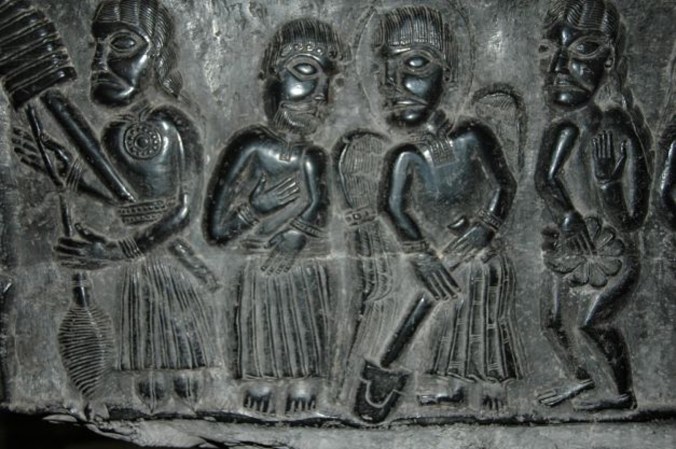
Black Tournai marble font in All Saints, East Meon, Hampshire
Look out also, for ‘Holy Water Stoups.’ These were also often placed by the main entrance; in pre-Reformation days, they would have enabled worshippers to dip their finger in the water previously blessed by the priest and then cross themselves, as an act of self-blessing. Since the Reformation, they’ve mostly been unused, but can be seen in many places. If you see something that looks similar in a chancel, the likelihood is that it is not a ‘stoup,’ but a ‘piscina’ – an area where the holy vessels are washed clean after Communion. A clue is that if there is a ‘drain hole’ at the bottom, it is likely a piscina.
Fonts vary hugely, as you can see from these two photos:
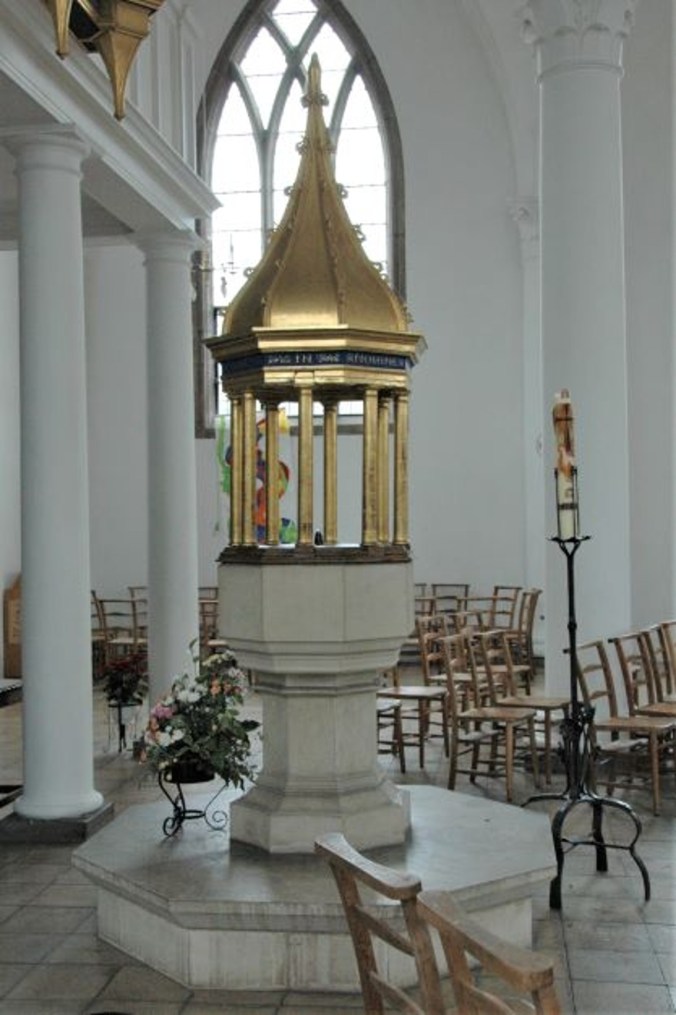
Font at St Philip, Cosham, Hampshire by the famous church designer Sir Ninian Comper
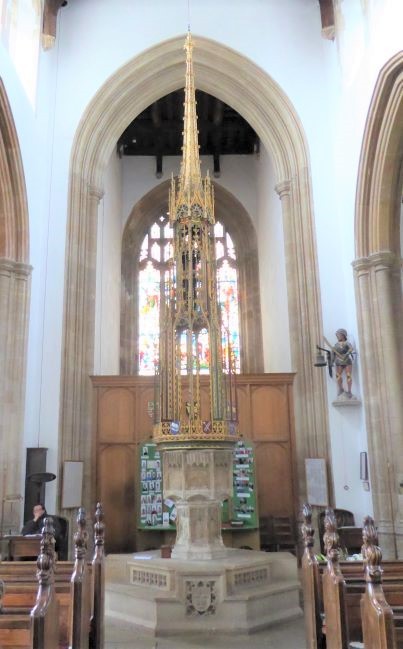
Font Cover at St Edmund, Southwold, Suffolk
Reredos
A reredos is a decorative screen that covers the wall behind the altar. They were often hugely decorative, and because of that, often fell foul of Puritan iconoclasts. Of the ones that remain of an early period, probably the best is at Christchurch Priory in Dorset (itself a most important, cathedral-quality church), which probably dates from about 1340:
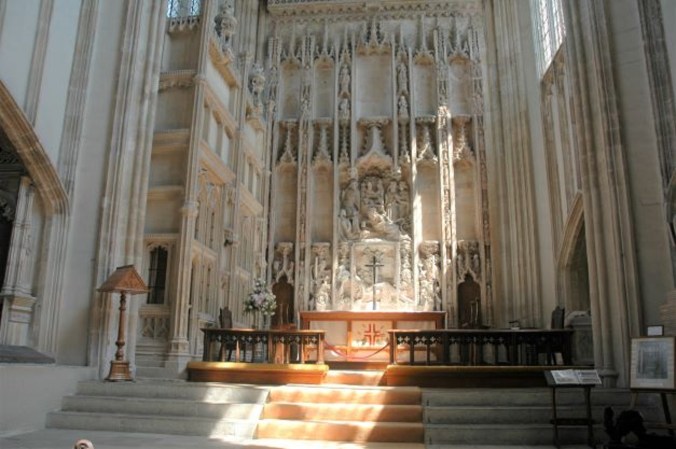
Magnificent reredos at Christchurch Priory, Dorset
Misericords
Often it is possible to see items in churches that underline a sharp sense of humour of times gone by. One of the best places to look for such work are ‘misericords,’ which can be found often in the choir stalls of cathedrals or monastic churches. These are seats, which tip up and, in that state, provide the opportunity for the user to rest his posterior on a carved ‘shelf’, whilst appearing to remain standing; they must have been a great boon through the immensely long services – the word means ‘mercy’.
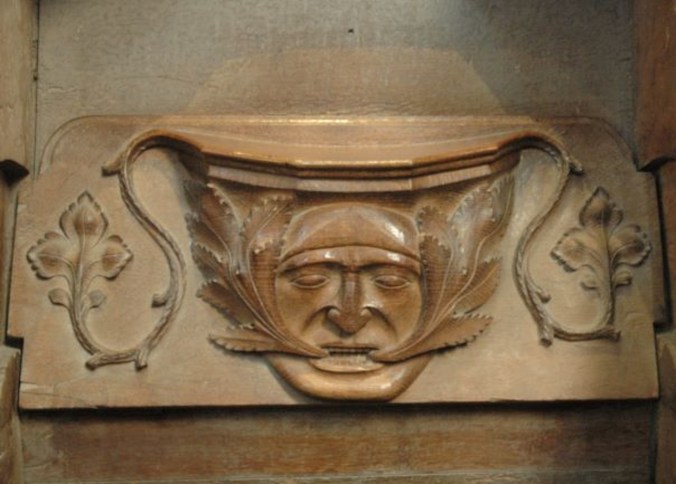
A ‘Green Man’ misericord from St David’s Cathedral (or a ‘Green Nun’?)
Other carved woodwork is also sometimes a cause for humour, as in this case, where the carving separating two choir stalls depicts a fox in the pulpit preaching to geese in the pews:
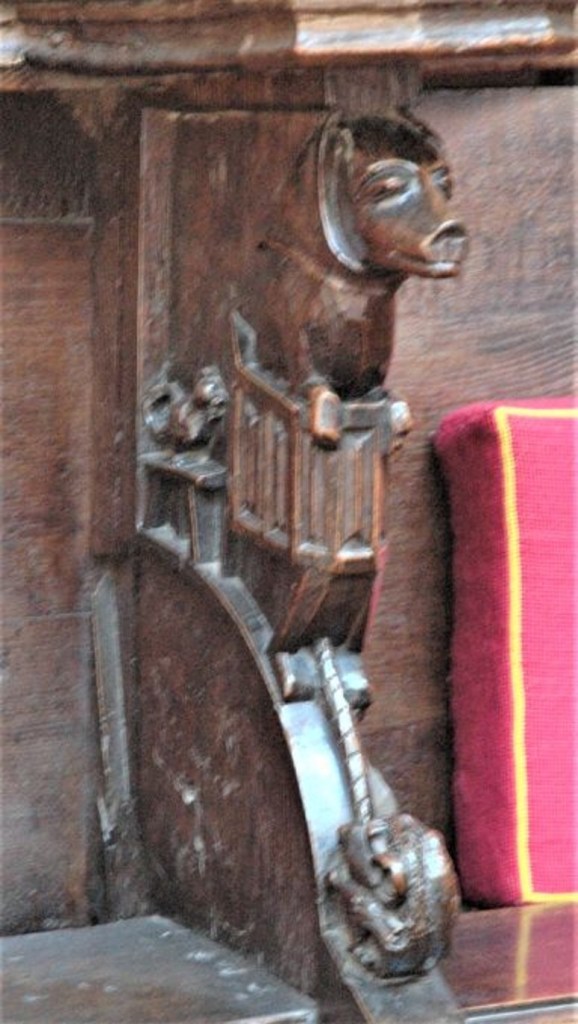
Medieval Humour: a fox in the pulpit
Lists of vicars
Many churches have wooden boards that show the names of the vicars through the centuries. It can be revealing to look at the dates when the Black Death ravaged communities, between 1341 and 1350. Between 50% and 60% of victims died, and it is sometimes possible to see several priests had served during this short period, following the death of the ‘incumbent’ (word used to denote the senior priest, who held the ‘living’ of the church in that place). In addition, the Reformation was a time of great upheaval, when many priests were ‘ousted’ from their posts, only to be replaced again a few years later when the Roman Catholic Queen (‘Bloody’) Mary I came to the throne. Later in history, the Puritan years resulted in many priests falling foul of their church hierarchies. The following board from All Saints, Hursley in Hampshire shows John Hinton ‘deprived’ of his ‘living’ (a term meaning both church role and income) in 1565, John Hardy ‘ejected’ in 1644 and ‘Several Puritan Intruders’ served between 1646 and 1660. We can only imagine the misery that must lie behind such bald comments. A charity that helped those ousted still exists (Sons of the Clergy) and these days helps those who fall into financial difficulty.
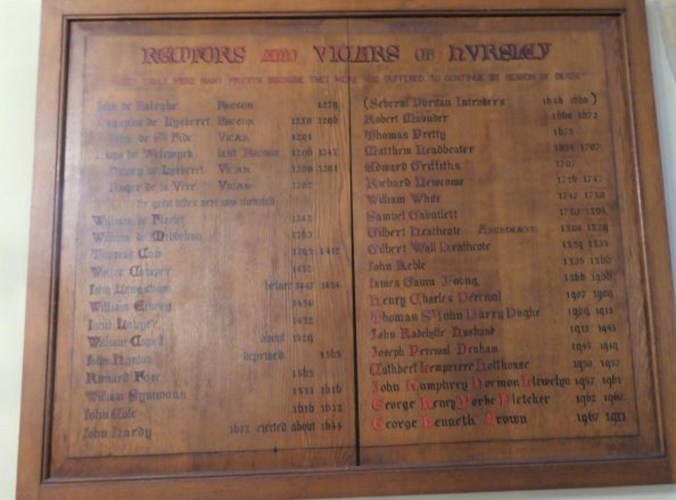
Tell-tale list of vicars from All Saints, Hursley, Hampshire
Hatchments
In addition to monuments and memorials, it is not unusual for the ‘great and the good’ to have their ‘Funeral Hatchments’ in churches. These are diamond-shaped heraldic panels, often fixed to a wall and they depict the dead person both through the family’s coat of arms and mottos, but also through heraldic emblems. Often a vertical split can be seen, with the husband’s emblems on the left, and the wife’s on the right. These hatchments all follow the same rules, with different styles for widows, widowers and so on. The example below shows that of a bachelor. Had the person in question been married, his wife’s emblems would have been seen on the right-hand side of the diamond. Whole books have been written about how to interpret these items.
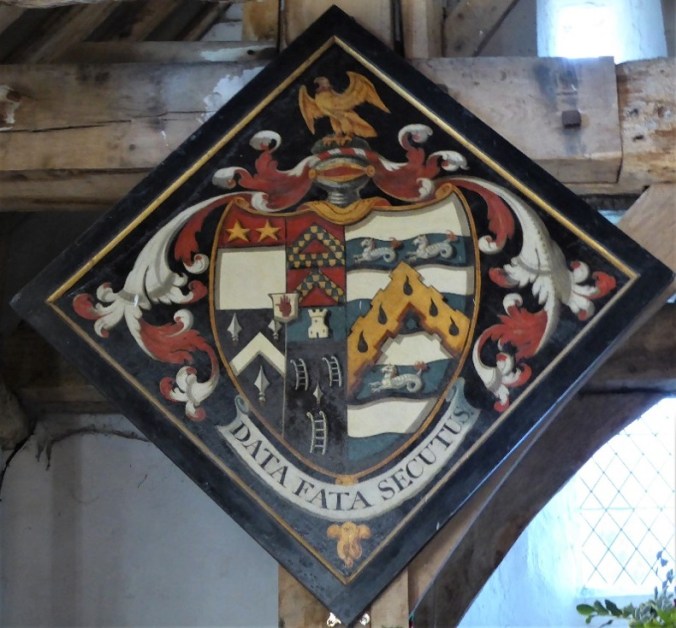
Funerary Hatchment in Farley Chamberlayne, Hampshire
Anchorite cells
An ‘Anchorite’ was a religious recluse. They were differentiated from ‘Hermits’ by not serving the community, but instead were quite literally ‘walled up’ inside very confined areas within churches, where they would pray for those who gave endowments, or other benefactors of the church or community; they were sometimes ‘sponsored.’ It’s hard to imagine how this could have been accepted within a Christian community, and they’re therefore rare. The ‘Cell’ in the picture below is of St Nicholas, Compton, Surrey. The door to the right is the entry to the cell. The photo also shows another rarity – a two story Chancel; in fact, this is the only one in England that I’m aware of.
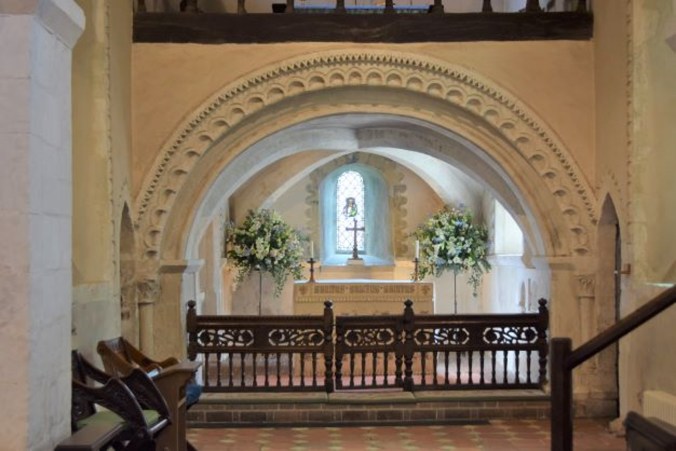
Anchorite Cell and two storey Chancel at St Nicholas, Compton, Surrey
Royal Coats of Arms
It’s not uncommon to find Royal Coats of Arms hanging in churches; I’ve been told that St Mary, Raydon, Suffolk was the first to use the arms of King Charles III. Some of these arms have been actively encouraged: during the reign of Charles I, the Archbishop of Canterbury instructed churches that royal arms should be painted or repaired, together with boards depicting the Ten Commandments or other holy sentences, which can again be seen in many places. The Royal Arms vary hugely in age, quality and size and are a whole area of study in themselves – how do you tell the difference between one monarch’s Arms and another? Only by intensive study of the various elements.
One of the curiosities is that most people will know that the ‘Kingdom’ of France, conquered by King Henry V, was mostly lost by his son, Henry VI, and the last claim to any part of France disappeared when Queen Mary I lost the town of Calais. But this didn’t prevent the Crown from continuing to claim ownership of France, right up to 1801! This is depicted in the use of the French emblem the ‘Fleur de Lys’ on all royal arms up to that date.
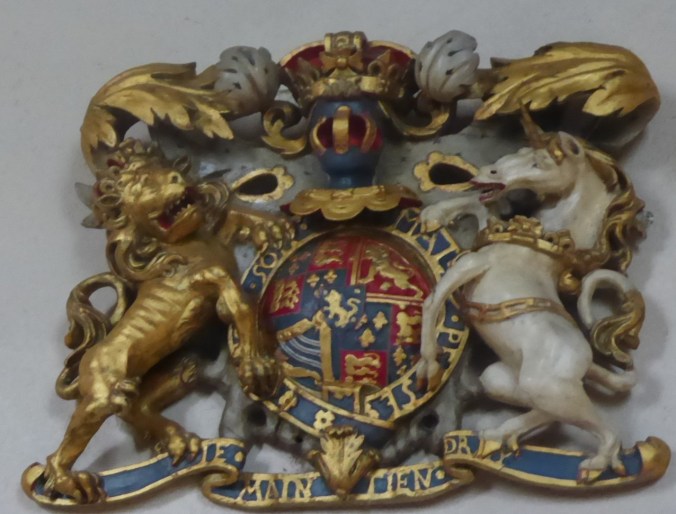
Royal Coat of Arms of King Charles II, claiming ownership of France 100 years after the last possession in France had been lost!
Stained glass
Stained Glass in churches is an incredibly difficult subject, and what follows is a view that will not be shared by everyone. I’m inclined to start this section with an anecdote. About 60 years ago, at a meeting of the Historic Churches Preservation Trust, a predecessor of mine as Director was asked in a meeting what he would do with small boys who threw stones at Stained Glass windows and damaged them. His response was that he would be inclined in most cases to give them a bucketful of more stones and encourage them to greater efforts!
Many people adore Stained Glass, so why am I not so keen? Well, the first and most important issue to understand is that the vast majority of high quality medieval stained glass in England was destroyed by the Puritan iconoclasts. It’s still possible to see some excellent examples in important churches, and these can be inspirational. There are also a fair number of windows that are made of fragments of recovered glass, and these can be very attractive, albeit sometimes difficult to analyse.
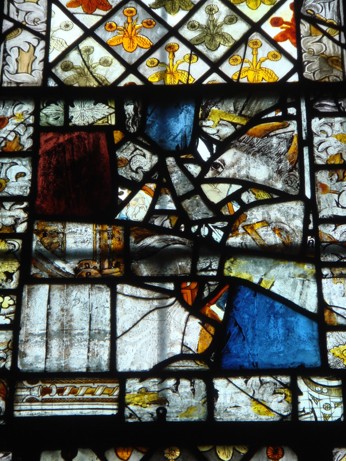
Window made of recovered fragments of medieval glass
One of the issues that I have with Victorian Stained Glass is that the Victorians loved their churches being dark; it made them feel more religious. On occasions I’ve been visiting churches in bright sunshine and have found that I almost had to feel my way around the church, once inside. There’s no doubt that the Iconoclasts (those Puritans who deliberately damaged depictions that offended their religious views) did us some favours, particularly in East Anglia, where Stained Glass was often replaced, for affordability reasons, with plain glass, so that some of the best ‘Wool Churches’ with massive Perpendicular windows and Clearstories (upper windows) are flooded with God’s natural light, thus enabling us to enjoy the rest of the internal details properly. Personally, I also find it more conducive to prayer, but I have to accept that this view is highly subjective.
Some other Stained Glass, particularly from the late Victorian era and in smaller, poor churches, can be of such bad quality that over the last 130 years, the details on the windows (faces, etc) have almost completely disappeared.
But (and it’s a big but), Stained Glass can be a really useful test of our Biblical knowledge. When visiting a church, I like to stand under a window and try to figure out what’s depicted in it. There are several reasons this can be a challenge.
Firstly, Stained Glass window designers can play fast and loose with the Bible, so that it’s possible to see a mix of things in the same window. For example, you may see St John, Mary Magdalene, the Virgin Mary, Peter and Roman soldiers in one window depicting the crucifixion, but there is no Gospel where they all appear together at the same time. Moses may look exactly like St Peter, adding to the challenge.
Secondly, how well do you know your Bible? If you were to see two bears and some children, would you know that this comes from 2 Kings 2:23-24? It’s one of those rather unattractive Old Testament stories, when the prophet Elisha curses some small boys who are poking fun at his bald head, and two bears come out of the woods and maul the children.
Thirdly, I wonder how well you think you know the symbols of the many saints? Most of us know that Peter has the keys to the kingdom and Paul the sword of truth. But how many of us know that St Jerome is identifiable by the fact that he’s accompanied by a tame lion, St James the Great has Cockle Shells and St Bartholomew has ‘flaying knives’ depicting the gruesome manner of his martyrdom? Even minor saints have their emblems. The Evangelist St John can sometimes be identified by the ‘poisoned chalice’ ie he may be holding a chalice with a snake emerging from it, but he can also often be confused for a woman, as he’s the only saint who’s always shown clean-shaven. Mary Magdalene is always identifiable by her long, uncovered, blond hair, but she’s also normally shown holding the ‘alabaster jar’, always assuming it can be identified as such, as the jar can sometimes look like a Starbucks coffee cup! As an example of this complexity, see the following picture; St John is clean-shaven, but what has he got under his arm? It’s supposed to be a book, to show that he is an evangelist, but it almost looks like a computer keyboard!
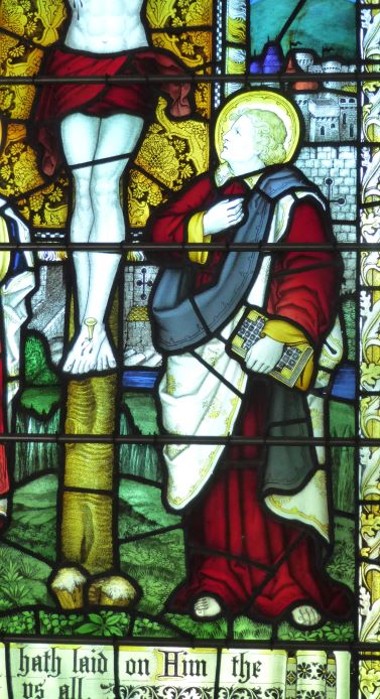
St John at the foot of the cross, but what is he holding?
Fourthly, just to confuse you, you may find that the window that you’re looking at is not from a Bible story at all, but instead depicts a piece of family history from those who paid for the window. The picture below shows a window from St Michael, Cheriton, Hampshire. The initial temptation is to believe that the window depicts St Michael the Archangel, to match the church dedication. A closer study reveals that the faces are derived from photographs contemporary with this 1919 window. All then falls into place; the window depicts the three nephews of Mary Egerton, all of whom were killed in the First World War.
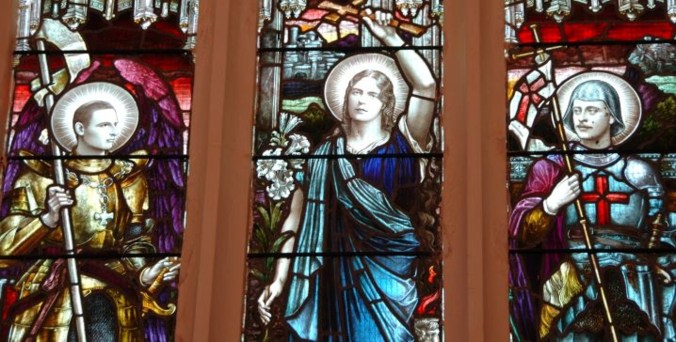
Lost family members in St Michael, Cheriton, Hampshire
But beware, some emblems are so obscure and the analogies now so distant, that you may have to walk away, confused.
In addition to family motifs, windows can also depict heraldry, or they can even be a mixture of Bible story, heraldry and family motifs!
Below is an example of an heraldic window:
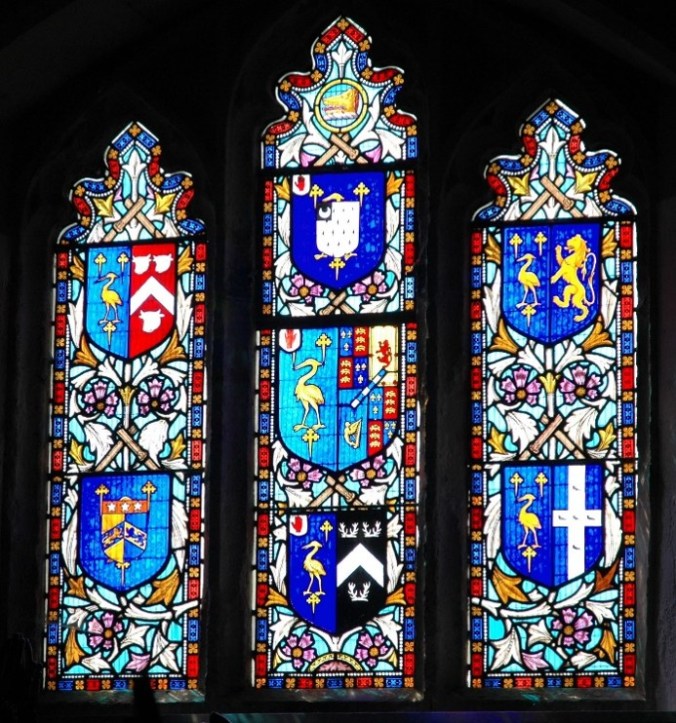
Heraldic arms in stained glass
Finally, with Stained Glass as with everything in churches, it’s essential to keep your eyes open. The following photo is of a window that depicts several different Biblical scenes. You might just be able to identify that on the right is the story of the soldiers casting lots for Jesus’s cloak. But you’ll have to stand close to the real window for ages, if you are to notice that the dice shows a combination of numbers that are not possible on real dice. What message is the designer trying to convey? It may be lost in the mists of time!
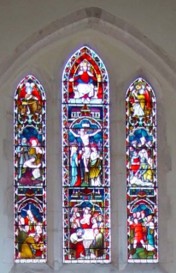
Soldiers casting lots on the right-hand side of this window
So the joys of church visiting are not restricted to architecture and history alone, but can also challenge your knowledge of Biblical issues and symbolism.
The last article in this series will cover what I think may be the most fascinating of all the joys that church buildings have to offer: their atmosphere, spirituality and oddities/eccentricities.
Discover more from Reflective Preacher
Subscribe to get the latest posts sent to your email.

